Showing posts with label Shag. Show all posts

Saturday, February 01, 2025

Øygarden 29.01- 01.02.2025 - Playing catch-up

Having spent some time in Oslo it was great to be back in Øygarden from a birding point of view - Oslo has some birds but in my day to day life there it is hard to find the time to get out to where they are. One of the main advantages of where I live is that "incidental" birding is just so much better. Going outside on my terrace or a trip to the shops is just so much more productive.

Quite a few birds turned up after a storm whilst I was away so it was a case of trying to catch up on stuff I had missed.

I arrived home after dark on 28.01. The following day I was stuck in meetings almost the entire day but managed to sneak out for an hour after work. Only a couple of White-tailed Eagle havørn and a flock of 25 Siskin grønnsisik from the house along with couple of Shags toppskarv that provided some interest by catching stuff. The long-staying Greylag grågås flock at Sæle gave a local new for the year. A flock of 22 Fieldfare gråtrost, two Redwing rødvingetrost, six Starling stær and eight Goldfinch stillits were also present here.

Fieldfare gråtrost at Sæle

2cy Shag toppskarv from my terrace

Shag toppskarv finally managed to swallow its catch - a Sea Scorption ulke.


The two long-staying Little Grebes dvergdykker were still present at Dåvøy.

On 30th January I managed a couple of hours out in a boat in pretty good conditions. Unsurprisingly this resulted in several new species for the year locally including Razorbill alke, Little Auk alkekonge and Guillemot lomvi. Black Guillemot teist were rather obvious with around 15 seen. A flock of over 20 Purple Sandpiper fjæreplytt, a few Oystercatcher tjeld , at least 12 White-tailed Eagle havørn and a Great Northern Diver islom were among the other sightings.


Guillemot lomvi near Hellesøy

After work I headed out again following a message about an albifrons White-fronted Goose tundragås at Breivik. I connected with this and picked up a male Tufted Duck toppand on Husvatnet on the way home.

albifrons Whitefront tundragås at Breivik

Friday 31st was a particularly frustrating day as the weather was just fantastic. After work (thank goodness the days are getting longer!) I popped in at Tjeldstø for a few minutes, here a Turnstone steinvender was new for the year. Four Purple Sandpiper fjærplytt, a Long-tailed Duck havelle and one of last year's White-tailed Eagle havørn all showed well, if rather distantly in the scope.

After this I kicked off the year's fishing with a 4.5kg Cod torsk , a decent haul of Whiting hviting and a squid.

On 1st February I took my first trip to Skogsøy where a Great Northern Diver islom gave point blank views as it flew south moments after I sat down. Things were generally rather quiet but a Kittiwake krykkje heading north, a Gannet havsule heading south and a single Little Auk alkekonge meant it was not a complete waste of time.

3cy White-tailed Eagle havørn at Skogsøy - one of four White-tailed Eagle seen at this locality.

The way home produced a couple of Mute Swan knoppsvane at Sture (still not a common bird in northern Øygarden) and eight Collared Dove tyrkedue at Oen.


Mute Swans knoppsvane at Sture - probably the same bird that turned up at Hellesøy in December.


Tuesday, July 10, 2018

Nøvlingane 08 July 2018 - The Young Ones

Calm sunny and very nice weather to be out and about in.

This is nothing to do with the cult British TV comedy series from the '80s :)

We took a boat trip to look around the islands to check out what was going on.


Whimbrels småspove - a sure sign that autumn migration has begun.

Migration wise a flock of 8 Whimbrel småspove put in an appearance close to Nautnes.

One of a few families of Eiders ærfugl seen today.

Young Great black-backed Gulls svartbak


Grey Seal havert

Young Herring Gull gråmåke

Lesser Black Backed Gull sildemåke - by far in the minority out on the islands

One of several young Oystercatcher tjeld seen.

Adult Oystercatcher tjeld with limpit. Of more interest is that this bird is ringed....highly likely to have been ringed on the south coast of the UK if experience is anything to go by.

Raven ravn

Rock Pipit skjærpiplerke really living up to it's name


Shag toppskarv

Other than these it was just the usual breeding birds including a single Black Guillemot teist, several Cormorants storskarv among the local Shags toppskarv, Oystercatchers tjeld, Eider ærfugl and the usual gull species. There were plenty of young Herring Gulls gråmåke and Great Black-backed Gulls svartbak on several of the islands.

Other stuff included a White-tailed Eagle havørn, a couple of Raven ravn, Rock Pipits skjærpiplerke and a couple of Gannets havsule. Several Arctic Tern rødnebbterne were seen but none on the island that looked so promising earlier in the year.

As is so often the case a couple of Grey Seal havert were hanging around.

Tuesday, August 29, 2017

Spanish ringed Shag in Øygarden - a first for Norway - or not

Update 31.08.2017:
Following what I believed to be the first record of a Spanish ringed Shag in Norway further information has come to light. It seems that a scheme not registered on the European Colour-ringed Birding site has been started in Rogaland using the same colours and codes as the Spanish scheme. So it is more likely that the bird mentioned below was part of the Norwegian project. To me this is a ridiculous situation as it is within the realms of possibility that birds from UK can be seen in both Norway and Spain such that there is a definite chance of overlapping ranges between these colour ringing projects. Why has the Norwegian project not been registered?  How is it possible for field observers who will probably not be able to read the metal ring to differentiate between these two schemes?

Original post:
Here is an update that I just HAD to post despite not knowing all the details yet. This is what makes birding so great - finding out about stuff like this.

The colour-ringed Shag toppskarv photographed on Saturday WAS ringed in SPAIN!!!

To quote the mail I received:

....We ringed it on 2012 at Lekeitio (Basque Country, northern Spain)......

On Saturday I had already checked a couple of ringing Atlases (both the Norwegian ringmerkingsatlas and the UK's Atlas of Bird Migration - the latter being my favourite book by the way). The Norwegian book did not mention any recoveries from Spain whereas some birds ringed in the UK have turned up there.

To make sure I have visited one of the best websites ever in the world of birding  and done some double checking.

First all the foreign ringed birds recovered in Norway (none from Spain):


and then all the Norwegian ringed birds recovered abroad:


In other words no birds from Norway have been recovered in Spain and no birds from Spain have been recovered in Norway before.

Amazing for a bird that is not considered to move very far!!

Thursday, August 10, 2017

Skogsøy 10 August 2017 - Pavlovian response to onshore winds

A fresh onshore breeze meant that there was no choice but to head out to Skogsøy. There were, of course, no shearwaters - I see them just as often with the wind in the east or at least anywhere but west.


Sometimes one can get lucky and get the whole bird in....

The more usual result when photographing diving Gannets havsule


Something approaching my dream shot of Shag toppskarv. If only it was in focus....
The fish looks like a Short-spined Sea Scorpion


Most Shags toppskarv today were first year birds - perhaps they migrate north before the adults...

It was relatively quiet with just a southbound migration of Oystercatchers tjeld, the autumn northward migration of Shags toppskarv (most of which were this year's birds) and small numbers of Gannet havsule.

A couple of White-tailed Eagles havørn did some seawatching from the next headland south, one of which was there when I arrived and left at the same time.

Tuesday, February 14, 2017

Øygarden 14 February - I love SEAPOP

Indescribable weather! Calm and sunny - in other words perfect conditions for messing around in boats- which is just as well as today was the annual SEAPOP count - in other words counting seabirds from a small boat.

Most of this was done in Øygarden but with a brief foray into the neighbouring district of Fjell.

Black Guillemot teist

A common sight today - mixed flock of Cormorants storskarv and Shag toppskarv resting on the islands

Bachekor boys - an almost all male group of Eiders ærfugl. The lone female was getting rather a lot of attention....

Male Eider ærfugl

Male Long-tailed Duck havelle

....with a more typical shot - not easy trying to take pictures of moving birds from a moving boat


Purple Sandpipers fjæreplytt - this flock was of around 70 birds

Shags toppskarv - adult on the left, presumed 2cy bird on the right

Conditions were great even if the numbers of most of the seaduck were not. NO Velvet Scoter sjøorre seen and only TWO Common Scoter svartand seen from the boat. Numbers of Long-tailed Duck havelle and Eider ærfugl also seemed down on usual. Although I don't have the data from previous years I am pretty sure gull numbers were also much reduced compared to normal and with very few immatures.

However, Black Guillemot teist, White-tailed Eagle havørn and Purple Sandpiper fjæreplytt were around normal.

Dipper at dawn

Other stuff today included a Dipper fossekall near Alvheim and the first Black Guillemot teist I've seen from the terrace this year.

I also saw a distant flock of four grey geese (quite possibly Bean) flying north and apparently going down but I didn't see them on my way home.

Thursday, November 10, 2016

Herdlevær 10 November 2016 - Dead interesting

Although only a degree or two up from the last few days it felt a lot warmer.

Dead deer hjort - obviously someone has had a successful hunting season....

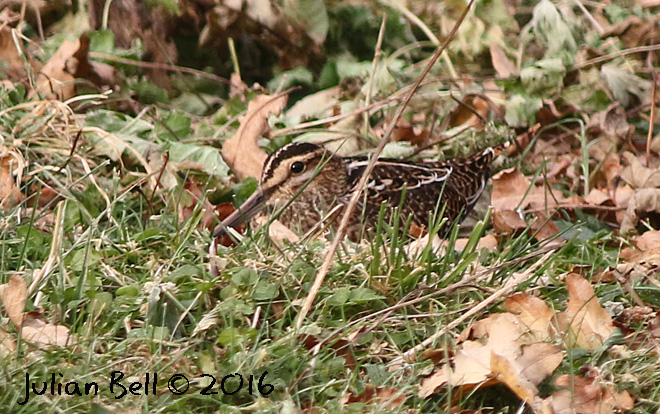
Remains of Snipe enkeltbekkasin

...and Woodcock rugde

The cold weather has obviously made some things easier for predators to catch, there was quite a bit of dead stuff about today including a Snipe enkeltbekkasin and a Woodcock rugde. These, along with other recently killed birds makes it looks like there is a raptor living the dream at Herdlevær....


Still quite a few Common Gull fiskemåke present - won't be long before these disappear and the species becomes hard to find in Øygarden. Crazy as large numbers overwinter in Bergen.

Small numbers of Common Scoter svartand around but no real movement

Linnet tornirisk

Redwing rødvingetrost


Shag toppskarv - so common it tends to get a bit neglected from the photo side of things

One of a couple of Snipe enkeltbekkasin that were still alive

What would have been a nice shot of Wren gjerdesmett had it not been for the fence


However, there were quite a few birds still very much alive. The most unusual sighting was the first November record of Linnet tornirisk for Øygarden. Otherwise is was very much the usual November fare with Red-throated Diver smålom, Long-tailed Duck havelle, a couple of Snipe enkeltbekkasin and so on.

Two male Scaup bergand

Scaup bergand (front right), Tufted Duck toppand (front left) and Wigeon brunnakke (back)

Two Scaup bergand and two Tufted Duck toppand

Two Tufted Duck toppand in the middle with Scaup bergand on either side


Drive-bys at Tjeldstø and Alvheim produced a few Scaup bergand and five other species of duck.

Early morning Razorbill alke at Nautnes


A Razorbill alke swam past the terrace early in the morning.