Friday, April 27, 2018

Skogsøy 27 April 2018 - Svalbard here we come!

Light southerly winds, mixed cloud cover with sunny spells.

As is now the last week of April it was somewhat predictable that I got up at silly o clock and went off to Skogsøy for a few hours before work.....

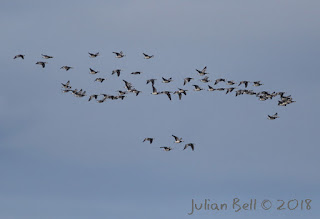
This flock looks like it is heading the wrong way to Svalbard but was the first flock I saw passing behind the lookput.

Some flocks were picked up a long was off over land....


Other flocks came rather closer.....


One of today's Gannets havsule

Rock Pipit skjærpiplerke with nest material

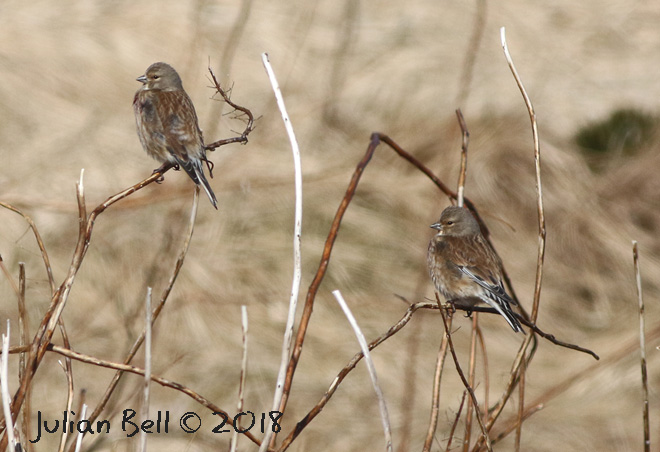
One of two Twite bergirisk I saw during a drive-by at Herdlevær

I spent a little of three hours there and had a decent passage of Barnacle Geese hvitkinngås heading north on their way to Svalbard. I am pretty certain that a number of flocks passed more or less undetected behind the lookout - I saw some flocks behind me but heard others that I just didn't see.....Although far from any kind of record the final tally was just under 800 birds. These were the first I have seen locally this year, although the first flock was observed here on 21.04.

Other than the geese there was very little passing and remarkably no divers at all. Small numbers of the usual seaduck (largely Common Scoter svartand and Long-tailed Duck havelle) passed including the first two Velvet Scoter sjøorre of the year - it has been the worst winter ever for this species in Øygarden. A light movement of Oystercatcher tjeld was also noted along with the usual Gannets havsule, Shags toppskarv and a single Guillemot lomvi.

A Rock Pipit skjærpiplerke gathered nesting material close to where I was sitting - it is not always obvious if the Rock Pipits we see are local breeders or birds passing through.

Another new for the year were a couple of Lesser Whitethroat møller - one feeding and picked up on call, whilst the other bird was in full song.


Tuesday, April 24, 2018

Øygarden 22.04-24.04 First Cuckoo of the 2018 for Norway

After a manic period of work which saw me on four different vessels in less than a week in Bergen, Aberdeen, Sløvåg and Austevoll I finally made it home and managed to catch up a little.

Part of a flock of 45 Curlew storspove that flew in off the sea and over my house

One of at least two Great Spotted Woodpecker flaggspett that have been frequenting my garden of late

On 22.04 a late and lazy seawatch produced little other than the usual Gannet havsule, a Kittiwake krykkje and several Guillemots lomvi. Back home at Nautnes the highlight was a flock of 45 Curlew storspove that flew over the house after the rain set in. Twite bergirisk over my terrace was my first of the year as was a singing Willow Warbler løvsanger.

On 23.04 the best birds were at Tjeldstø with Hawifinch kjernebiter the best of the bunch,other sightings included a couple of Pied Wagtail svartryggerle among all the White Wagtails linerle, a flock of 20 Brambling bjørkefink and a hunting Peregrine vandrefalk.

Woodcock rugde was seen roding at Nautnes in the evening as usual.

The 24th saw a bit more time out and about. This resulted in the first Cuckoo gjøk for Norway at Tjeldstø - and the earliest ever record for Øygarden. The Hawfinch kjernebiter put in an appearance again and a Goldfinch stillits turned up at the same place. A pair of Shelduck gravand flying low over Rotevatnet were another good sighting for this locality. Other migrants included several Golden Plover heilo and Brambling bjørkefink. A Guillemot lomvi fed on the sea along with a Common Scoter svartand (both species were also present the previous day).

Once the rain stopped it was time for a trip out to Skogsøy where a male Blackcap munk was something of a surprise on the way out - the first for Øygarden this year at a rather unusual locality. Rather more expected was a single adult White-billed Diver gulnebblom and around 20 Red-throated Diver smålom during an hour and a half of seawatching between 12:15 and 13:45-

Tuesday, April 17, 2018

Tjeldstø 17 April 2018 - Lunchbreak

Light cloud with southerly winds.

I have been travelling a lot the last few days and today I had to work from home. A short lunch break at Tjeldtsø provided some interest with a neck-ringed Greylag grågås ringed near Karstø last summer. Rather early for a young bird from Tjeldstø to have moved south so early - but who knows when the first chicks hatch late April / early May and by late June Greylag numbers are dropping in Øygarden....

It is always cool to see colour ringed birds but yet again this project has yet to be registered on http://www.cr-birding.org/

After some detective work it seems that http://www.geese.org/ is the place to report such sightings.


Greylag grågås VJ3 feeding near Husvatnet, Tjeldstø

From the life history of this bird...


This Heron gråhegre caught several stikkleacks stingsild whilst I watched.
Evidence that fish-eating birds can actually benefit game fisheries (there are trout ørret in this lake).
Hunters and fishermen often want to get rid of birds like Herons and Cormorants but time and again it is proved that they eat species that prey either eat the eggs of more desirable species and / or are in competition for food with Trout etc. 

Newborn lambs - lots more than a few days ago and very obviously a lot more imminent - judging by the size of many of the sheep....


Other species included Redshank rødstilk, a few White-tailed Eagles havørn, Wheatears steinskvett and so on.

Wednesday, April 11, 2018

Tjeldstø 11 April 2018 - First Swallow and ton up in Øygarden

Calm and sunny in the morning, light northerly breeze later.

Cracking weather again and thus not much in the way of grounded migrants. However, plenty of new arrivals busy setting up territories.

The first new for the year came before I even left the house in the form of the first Swallow låvesvale of the year heading north - not a bad date for the first of the year but by no means a record either. In addition both Lesser Redpoll brunsisik and Siskin grønnsisik were seen from my terrace.


Chiff-chaff gransanger at Tjeldstø

A Greylag grågås enjoying the good conditions


Mr and Mrs Teal krikkand - a few pairs getting themselves sorted out now. The bubbles in the water are due to a rather splashy landing moments before the pictures were taken.


A walk at Tjeldstø produced my first Redshank rødstilk of the year - and meant that I went ton up in Øygarden. Wheatear steinskvett and Chiff-chaff gransanger were both singing and four species of wader were displaying.

A drive-by at Herdlevær produced a Mistle Thrush duetrost.

I spent most of the day doing housework, changing from winter to summer tyres on the car etc but took a precautionary spin with the car once the summer wheels were on. This short drive gave, among other things, a Carrion Crow svartkråke and another Chiff-chaff gransanger.

Tuesday, April 10, 2018

Skogsøy 10 April 2018 - Another switch has been thrown

Calm and sunny during the morning, northerly breeze later.

Given the weather forecast combined with the dull and wet conditions of the last couple of days I somewhat predictably spent the first few hours of the day seawatching. Things went almost exactly as expected - a very decent passage of Common Gulls fiskemåke, the first Red-throated Diver smålom of the year and some Cormorant storskarv and Shag toppskarv migration. Over 3000 birds logged.

Migrating Common Gulls fiskemåke

Some gull flocks passed overhead - here with a lone Black-headed Gull hettemåke amongst them


Cormorants storskarv have started migrating now

Great Northern Diver islom on it's way north

Two of the three Linnets tornirisk seen during a drive-by at Herdlevær after the seawatching

Rock Pipit skjærpiplerke at the lookout point - obviously part of a pair that has settled in for the season

One of many southbound Shag toppskarv flocks today

Shelduck gravand pair. The white specks above and below them are instantly recognisable as distant Common Gulls fiskemåke

The Common Gulls fiskemåke passed at height and generally at long range, although some flocks passed overhead.

Other birds of note were a single Great Northern Diver islom and a couple of Shelduck gravand heading north.

Passerines were thin on the ground, though a few Skylark sanglerke passed overhead.

Woodcock rugde roding over my house again in the evening.

The totals for a little over three hours seawatching (07:00-10:10) were as follows:

Red throated Diver N 1
Great Northern Diver N 1
Northern Gannet S 5
Great Cormorant N 82
Great Cormorant S 2
Eurasian Shag N 4
Eurasian Shag S 190
Greylag Goose S 2
Shelduck N 2
Eider S 4
Common Scoter S 18
Merganser N 2
Merganser S 2
Oystercatcher N 8
Eurasian Curlew N 2
Black headed Gull N 4
Common Gull N 2790
Common Guillemot N 2
Auk N 1


The Shag toppskarv count was rather high for the time of year (normally this species passes in this kind of number earlier in the year). The very small numbers of Oystercatcher tjeld is perhaps surprising but there has been a lot of good migration weather of late and the peak is probably past. 

Monday, April 09, 2018

Herdlevær 09 April 2018 - Dodgy gull and Hawfinch

Calm with low cloud and drizzle again.

Did a quick check at Herdlevær where I had my first Chiff-chaff gransanger and Dunnock jernspurv of the year. Other than that there were Meadow Pipits heipiplerke setting up territories, a Pied Wagtail svartryggerle, Wheatear steinskvett, displaying Snipe enkeltbekkasin and a lone Long-tailed Duck havelle.


The top right bird had bright yellow legs but is likely to be an omissus Herring Gull. No open wing shots....

A drive-by at Tjeldstø produced a dodgy looking gull which disappeared whilst I was parking the car in order to study the bird in  more detail, may well just be an omissus Herring Gull gråmåke as it seemed quite dainty compared to a normal Herring Gull.

Occurrence of Hawfinch in Øygarden (from artsobs)

A short trip out in the evening gave brief views of a Hawfinch kjernebiter, Brambling bjørkefink and the usual. The Hawfinch was very shy and although seen well with binoculars it flew as soon as I even tried to touch my camera. This is quite a rare species in Øygarden although it has been pretty much annual for the last several years.

Woodock rugde roding over my house at Nautnes and a smattering of migrants here too.

Sunday, April 08, 2018

Tjeldstø 08 April 2018 - Survivor

Low cloud with light drizzle much of the day.


I spent much of the day getting stuff done in the house and, more importantly, garden today and only did a cursory look at Tjeldstø. The weather was obviously to blame for a number of grounded migrants - notably a flock of around 25 Meadow Pipits heipiplerke but also a couple of Pied Wagtails svartryggerle and a few White Wagtails linerle.

The only new bird for the year was a flyover Golden Plover heilo.


The Water Rail vannrikse which has spent even the coldest part of the winter here showed briefly today - though my camera stopped functioning at a rather critical moment so the pictures are nothing like as good as they could have been. I'm very glad this bird made it through the winter and was surprised to see it today as there are now unlimited areas for this bird to find food....maybe the feeding earlier in the year helped it survive through what must have been an exceedingly difficult period.

Saturday, April 07, 2018

Øygarden 07 April 2018 - Spring boost

Light southerly winds, overcast at first but sunny later.

A quick look at a few localities to see what was going on today. Short walks at Herdlevær, Breivik and Tjeldstø produced several new for the year.


A couple of White Wagtail linerle and a Snipe enkeltbekkasin

Part of a flock of Starling stær at Breivik


I opened at Herdlevær which was relatively quiet. Breivik proved to be rather better with a Pied Wagtail svartryggerle along with a few White Wagtail linerle, several Meadow Pipit heipiplerke, a Snipe enkeltbekkasin, a flock of at least 170 Starling stær and an assortment of the usual thrushes.


Skylarks sanglerke at Tjeldstø


Tjeldstø was rather better with highlights being a flyover Grey Wagtail vintererle, a Mistle Thrush duetrost, a Snow Bunting snøspurv, four Whetear steinskvett, a Lesser Black-backed Gull sildemåke, a few Teal krikkand, a flock of three Tufted Duck toppand, a White Wagtail linerle, a Brambling bjørkefink, five Skylark sanglerke and at least seven Meadow Pipit heipiplerke. White-tailed Eagle havørn and most of the usual suspects also noted here alongside several each of displaying Curlew storspove and Lapwing vipe.

Curlew storspove - many more have arrived whilst I have been away. This one was at Dåvøy - the others were displaying at various localities

A pair of Ringed Plover sandlo are back on one of their regular breeding sites whilst at Nautnes a Goldcrest fuglekonge was the first of the year in the garden as was a Lesser Black-backed Gull sildemåke along with the more usual White-tailed Eagle havørn.

Thursday, April 05, 2018

Engerdal Late March - Early April - Eastern Easter

I spent Easter in eastern Norway. The contrast between migration and flowers in bloom at my house to metres of snow and temperatures down to -20 C could not have been greater.

Hazel Grouse jerpe - a typical view

Some wonderful skiing in fantastic weather did not produce the usual specialities - although there were plenty of tracks of various game birds and a distant flock of large finches which were very likely to have been Pine Grosbeak konglebit.  I did connect with Hazel Grouse jerpe a few times at a regular site I have for this species, had drumming Black Woodpecker svartspett from the garden and saw some small signs of spring migration in the form of Whoopers sangsvane arriving to a completely frozen lake and a Blackbird svarttrost.

Pygmy Owl spurveugle

A stopover at Hamar produced a cracking Pygmy Owl spurveugle being mobbed by a flock of tits.