Showing posts with label omissus. Show all posts

Saturday, November 23, 2024

Kårstø and Oslo - 12.11-21.11.2024 - Work calls

A few days on an inshore job near Kårstø 12-14 November were great fun. Cool equipment and good data:) And some birds thrown in.

Horned Grebes horndykker, a good selection of seaduck, a couple of diver species and some White-tailed Eagles havørn meant the days at work flew by.

Adult Great Northern Diver islom

Black Guillemot teist

Long-tailed Duck havelle

Velvet Scoter sjøorre

After that it was off to Oslo for some meetings and consequently nothing much to see. I managed a couple of hours on Gressholmen on 17 November where large numbers of Goldeneye kvinand were joined by a couple of Scaup bergand. Not much in the way of passerines but still plenty of berries around in the east - along with some Fieldfare gråtrost and a lone Redwing rødvingetrost feeding on them. An omissus type Herring Gull gråmåke on Nakkholmen made me look twice:)


Two Scaup bergand joined well over 100 Goldeneye kvinand

Almost orange legs on this omissus type Herring Gull gråmåke. No open wing shots and this photo is rather overexposed.


Saturday, March 14, 2020

Dåvøy and Hjelme 13 March 2020 - Just checking

Decent weather, if rather chilly, for most of the day. Didn't really go out but quickly did a few drive-bys here and there.


Some massively cropped images of the female Stonechat svartstrupe

The Stonechat svartstrupe was still present and proved popular with birders from town and must thus classify as the first twitch of the year out here. It proved just as frustrating to follow and document as it has the last few days. Some birders are working from home due to the corona virus and could thus make the trip to see this bird - a silver lining in these chaotic times.

This got me thinking that if a mega is found what will people do then? A massive crowd of twitchers would be rather unethical in the current situation......I hope I get the chance to see what happens!


Some more shots of the difficult to identify gull with yellow legs 

I checked Dåvøy quickly and the infuriating gull-with-yellow-legs showed very well. Although I have seen it quite a few times this year today gave the best photo opportunities. I have swung from YLG to HG and back again a few times, and although I have definitely been in the YLG camp at times I am now in doubt again. Sometimes I wish it would just go away so I don't have to read all the YLG ID literature again and again and again.

In sheer desparation I started a thread on the WP gulls FB group here - and the helpful gull experts have been weighing in. Thanks to all who have helped so far😵

Mistle Thrush duetrost - a very shy species on this side of the North Sea!

A Mistle Thrush duetrost was reported at Hjelme so I dutifully headed out to see it. The timing for this record is a rather more normal record than the previous bird back in January.....

Tuesday, January 28, 2020

Øygarden 20-22 January - YLG

On 20 January I was not really out but found the "yellow-legged" gull at Dåvøy again. Having discussed this bird recently with other birders I am rapidly coming to the conclusion that it is a real Yellow-legged Gull gulbeinmåke.

The beak looks massive, bulky and with a prominent gonys. The red spot bleeds over to the upper mandible.

Rather round headed, red orbital ring and eye seems to be a shade darker than the Herring Gulls


All white tip on P10 can be a feature of birds from parts of the Med. Obvious black band on P5


The small size is obvious here in comparison to the local HGs.

A quick look through this blog shows that this bird is most likely a bird that has been seen repeatedly over several years:

Some examples
2019 (Feb)

The fact that P10 can be white on YLG is shown here on gull research. I think I need to dig up some of my YLG shots from the Mediterranean🙂

On 21 Janaury a flock of 19 Common Scoter svartand on the east side of Blomøy was one of the largest flocks reported in the county thus far this year. When exactly did things get this bad?? Seaduck numbers seem to heading just one way - and it is the wrong way.

A short seawatch at Skogsøy on 22 January produced a Gannet havsule, several Kittiwake krykkje and finally some auks - though they were too far off to be specifically identified they were guillebills alke/lomvi. On the sea small numbers of Eider ærfugl and singles of Black Guillemot teist and Long-tailed Duck havelle. Best bird here was a fly over Snow Bunting snøspurv (first for Hordaland this year). Good numbers of Siskin grønnsisik too about with a single flock of 120 flying over.

Monday, January 06, 2020

Dåvøy 06 January 2020 - Yellow legs.....

Near gale force southerly winds again but little rain. Little in the way of visibility so fairly hard going again today

Obviously darker than Herring Gull gråmåke (pro YLG feature)

Red spot on bill bleeding over to upper mandible - another pro YLG feature

Unfortunately the bird was spooked (possibly by Whooper Swans) before I managed to document the open wings...

This is the time of year those troublesome yellow-legged gulls turn up. Today a (the?) yellow legged gull turned up at Dåvøy - a regular spot for this to happen. It could potentially be a Yellow-legged Gull gulbeinmåke as it shows a number of pro YLG features - darker grey mantle, red eye ring, powerful bill with pronounced gonydal angle, red bill spot bleeding over to upper mandible, yellow legs, darker yellow eye and all white head. It was spooked by something before I managed to see the open wing properly - P10 looks to be all white (not good for YLG) but P5 does appear to be black (good for YLG). Or it could just be an omissus type Herring Gull gråmåke - hopefully some better shots of the wings will point ID in the right direction. The advanced moult (i.e. no streaking on the head) is obviously another pointer to YLG.

Red-breasted Merganser siland at Dåvøy

Also at Dåvøy the Grey Heron gråhegre roost numbered 46 birds which is a decent count.

A Peregrine vandrefalk hunted at Tjeldstø.

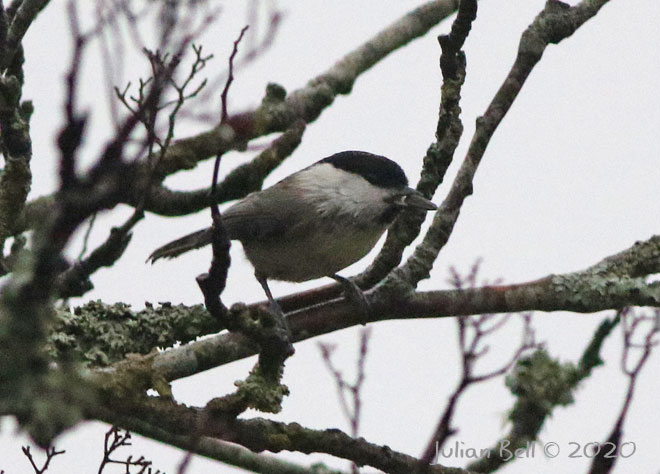
Willow Tit granmeis

The only definitely identified new for the year today were a couple of Willow Tit granmeis - although common enough inland it is not a common bird locally except during "invasion" years. In 2019 there were only three records of this species in Øygarden - none of which I managed to see.

Saturday, March 02, 2019

Øygarden 24.02 - 01.03 Drive-bys

A fantastic week weather wise. It was the half term holidays so this, combined with work, predictably meant there was little time spent out and about. However, spring has sprung and there has been something of interest most days even if most birding was either drive-bys or from the terrace/office.

6.5kg Cod torsk, just part of a very decent haul.

Crocus are in flower (and have been for a couple of weeks)


On 24.02 I abandoned plans for a birding trip in favour of fishing with my youngest. This turned out pretty well with two Cod torsk to 6.5kg and 5kg along with a few Haddock hyse (largest 3kg) and various other bits and bobs. With White-tailed Eagle havørn overhead, Curlew storspove and other birds this was a very nice afternoon. A short walk at Breivik in the morning produced little other than a couple of Skylark sanglerke - a species seen various places during the week.

The first Wigeon brunnakke I have seen in Øygarden this year (though one turned up whilst I was away a week or so ago)

Potentially one of the rarest birds for Øygarden this year - one of the four Mute Swans knoppsvane


The Mute Swans knoppsvane remained on Husvatnet all week - the longest staying birds in Øygarden ever! Other stuff seen at Tjeldstø during the week included the first Lapwing vipe of the year (28.02), two Wigeon brunnakke (all week), Greylag grågås  numbers continued to increase and VJ3 was seen  again on 28.02. Peregrine vandrefalk and up to five White-tailed Eagles havørn also put in an appearance here.

Whoopers sangsvane at Herdelvær 27.02

A short walk at Herdlevær on 27.02 was relatively quiet but the first migrating Oystercatcher tjeld passed during a coffee break.

Another new for Øygarden this year was a Common Gull fiskemåke at Vik on 25.02.

Migrating Herring Gulls gråmåke (compare wing pattern with pictures below)


Coal Tit svartmeis. Occasionally I take pictures of the common stuff too....


On 01.03 I did a cheeky pre-work seawatch - obvious movement of auks heading north but rather distant for the most part. Three White-tailed Eagles havørn joined 11 Raven ravn to eat something they found / stole on the shore - shortly afterwards some rather vocal Otters swam past...At least as good was a flock of over 50 Eiders ærfugl, proving they are not quite extinct yet.

Others who have been out and about of late have seen the first Shelduck gravand of the year, Goshawk hønsehauk, Little Auk alkekonge and more.

Potentially the most interesting bird of the week was a / the "yellow-legged" gull seen last week. This time I managed to see it a bit better and take some more photos. Although there are some features that point to Yellow-legged Gull gulbeinmåke I am not yet convinced of the identity. The amount of variation in these species certainly doesn't help.

Here the wing formula of Herring Gull gråmåke can be seen for comparison. No black on P5.

The gull to the left seems to have longer tibia, is slightly darker than the Herring Gull gråmåke to the right and has a longer primary projection along with less white in the primaries....

More primary tips visible (5) past the tertials on the yellow legged  gull and more beyond the tail too - so longer winged that the Herring Gull.

A more cropped image. darker eye than Herring Gull with red orbital ring (though this is also a feature of some Herring Gulls with yellow legs). Quite a heavy beak with pronounced gonys.

Variation in head shape. A Hooded Crow started alarming and this bird became nervous - I did not dare to turn away to see the cause of the alarm in case I could clinch an open wing shot....

Underwing shot


Top of wing shot. No white moons on mid-primaries and black band on P5 visible. BUT all white tip to P10 is not necessarily positive....

From the house up to three White-tailed Eagle havørn daily. Starling stær setting up territory, migrating Skyarks sanglerke a few times, Woodpigeon ringdue,  Common Crossbills grankorsnebb and daily Otter sightings.

Sunday, February 17, 2019

Øygarden 11.02 - 14.02 Signs of spring

Largely mild with southerly winds and a very spring-like feel.

Crocuses have started flowering and Snowdrops have been out for a couple of weeks at least, leaves are starting to show on my elderberry bushes so spring is in the air.

The only new bird for the year was a Skylark sanglerke migrating north over the house as I buried my newly installed fibre cable on 13.02 - a very early date for a migrating bird. A small influx of Starlings stær during the week (flocks of up to 10 birds seen) were almost certainly new arrivals. Great Black-backed Gulls svartbak numbers are increasing with many birds starting to find their favourite breeding spots out on the islands.


Yellow legs, red orbital eye ring, powerful bill with pronounced gonydal angle BUT looks like too much white in the primary tips (at least on these closed wing shots)....


As it is late winter / early spring it is time for those infruriating and time consuming "yellow-legged gulls". Or Omissus Herring Gulls gråmåke or whatever they are. I saw one such bird at Dåvøy on 12.02 and with legs, bill and orbital ring looking good my hopes were raised. However, no open wing shots to confirm either way but it looks like there may have been too much white on the outer primaries.....I noted also that the "Gulls" book mentions that omissus often also have red orbital ring....

Common Crossbill grankorsnebb at Hjelme Vest (part of a group of 16 birds that were also singing)

Random White-tailed Eagle havørn from the terrace

Monday, April 09, 2018

Herdlevær 09 April 2018 - Dodgy gull and Hawfinch

Calm with low cloud and drizzle again.

Did a quick check at Herdlevær where I had my first Chiff-chaff gransanger and Dunnock jernspurv of the year. Other than that there were Meadow Pipits heipiplerke setting up territories, a Pied Wagtail svartryggerle, Wheatear steinskvett, displaying Snipe enkeltbekkasin and a lone Long-tailed Duck havelle.


The top right bird had bright yellow legs but is likely to be an omissus Herring Gull. No open wing shots....

A drive-by at Tjeldstø produced a dodgy looking gull which disappeared whilst I was parking the car in order to study the bird in  more detail, may well just be an omissus Herring Gull gråmåke as it seemed quite dainty compared to a normal Herring Gull.

Occurrence of Hawfinch in Øygarden (from artsobs)

A short trip out in the evening gave brief views of a Hawfinch kjernebiter, Brambling bjørkefink and the usual. The Hawfinch was very shy and although seen well with binoculars it flew as soon as I even tried to touch my camera. This is quite a rare species in Øygarden although it has been pretty much annual for the last several years.

Woodock rugde roding over my house at Nautnes and a smattering of migrants here too.