Showing posts with label Yellow Wagtail. Show all posts

Wednesday, October 04, 2023

Øygarden 29.09-04.10 Some migrants at last!

After a couple of days at work in Aberdeen I was back home again. 

A  quick look at Sæle on 29.09 proved quite productive with the highlight being a 1cy Arctic Redpoll polarsisik - no photos as it disappeared too quickly but the white rump and unstreaked undertail coverts were seen. Other birds included my first local Garden Warblers hagesanger of the year and several Blackcap munk.

A Goshawk hønsehauk hunted past the home office window later in the day.

On 30th September I gave Skogsøy a go in, to put it mildly, challenging conditions. A strong onshore wind and showers didn't help and the birds were mostly flying either a long way out or with their backs to me or both. Several flocks of Red-throated Diver smålom and a flock of Barnacle Geese hvitkingås headed south as did a probable large shearwater, pale back and dark wings were the only features noted.

A flock of 30 Purple Sandpipers fjæreplytt at Tjeldstø were the first of the autumn for me whilst a Woodcock rugde at Hjelme was probably one of the local breeders.

It was a different story on 1st October with (finally) some passerines on the move. As I took my morning coffee on the terrace I had my first local Grey Wagtail vintererle and Bramblings bjørkefink passing over. 

I spent the morning out and about doing my usual round at Herdlevær first - here at least two Yellow-browed Warbler gulbrynsanger, a Yellow Wagtail gulerle, Whinchat buskskvett, Blackcaps munk, Garden Warbler hagesanger, Wheatear steinskvett, Common Sandpiper strandsnipe, Chiff-chaff gransanger and Reed Bunting sivspurv were among the many migrants noted. Flocks of finches and Meadow Pipits heipiplerke passed overhead constantly.

Whinchat buskskvett

Next up was Breivik which was fairly quiet - but flocks of Chaffinch bokfink and Meadow Pipits heipiplerke continued to pass. The usual Snipe enkeltbekkassin and Skylark sanglerke were also present.

At Tjeldstø a young White-tailed Eagle havørn gave good views as did a Dunlin myrsnipe together with two Golden Plover heilo. The first Goldeneye kvinand of the autumn also turned up here.
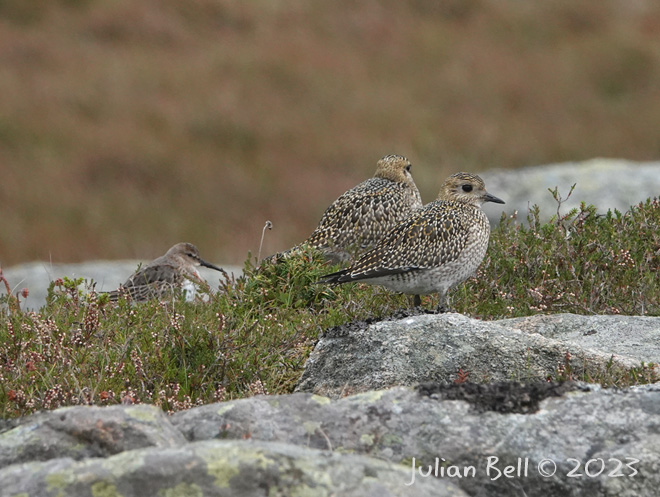
Dunlin myrsnipe with Golden Plover heilo

Young White-tailed Eagle havørn at Tjeldstø

On Monday I took the day off work and made an all too infrequent trip to Hernar. The southerly winds were rather stronger than forecast but there were plenty of birds about at least during the morning. Things tailed off after lunch and birds became harder to find. One interesting warbler evaded ID as it flew up from the grass and disappeared into sitka spruce never to be seen again - quite possibly a Reed Warbler rørsanger.

Birds that I did manage to identify included the first Tree Sparrows pilfink (a flock of six) for the island this year along with a female House Sparrow gråspurv which hung around for a bit. Migrants included several small flocks of Brambling bjørkefink, a Merlin dvergfalk, several Blackcap munk, a Willow Warbler løvsanger, a  Chiff-chaff gransanger, a few flyover Skylark sanglerke and a feeding Ruff brushane. Small numbers of Twite bergirisk remained, five White-tailed Eagle havørn simultaneously, the long-staying Great spotted Woodpecker flaggspett and a passage of Common Gulls fiskemåke, Lesser Black-backed Gulls sildemåke and Red-throated Diver smålom were among the other sightings.

Female House Sparrow gråspurv - an island rarity - probably not even annual on Hernar


Just one Linnet tornirisk left on the island


Ruff brushane

Didn't really leave the house on Tuesday and concentrated on work.

A walk at Breivik on 04 October was quite productive with at least four Jack Snipe kvartbekkassin, 10 Common Snipe enkeltbekkassin, Goldfinch stillits and more.

On the way home Tjeldstø produced no less than three Pintail stjertand. Sæle held at least five Blackcap munk and a couple of Chiff-chaff gransanger.


Pintails stjertand on Husvatnet


Monday, June 29, 2020

Besseggen 17-19 June 2020 - Run to the hills

Desperately hot for someone not keen on the heat so the mountains seemed like a good idea - and athough Besseggen was not my idea it is THE hike to do here in Norway and with things set to open up it seemed like an opportunity to avoid the worst of the crowds.

There is good birding to be had in the area so with Iron Maiden playing I drove a long way in a vain attempt to cool down....

Hen Harrier myrhauk and Rough-legged Buzzard fjellvåk flying over the road along Valdresflye made me want to to stop and see what was out there. However, these stops did not produce that much and I saw no waders at all. Further down from the plateau itself a Short-eared Owl jordugle hunted within view of the road and a cracking male Red-backed Shrike tornskate gave a deja vu feeling - having seen a pair in more or less the same place during a guiding trip a couple of years ago.


Roadside Red-backed Shrike tornskate


thunbergi Yellow Wagtails såerle


Besseggen was just incredible scenery-wise, we chose to hike behind the crowd that left the boat in order to avoid the selfie stick brigade. It was also far too hot to be walking / climbing. Species seen on the hike included a Bluethroat blåstrupe, several Ring Ousel ringtrost and some Ptarmigan fjellrype.


A male Ptarmigan fjellrype put on a show, initially to allow his mate to scuttle off to safety and then to see off another male.

This is the actual "Besseggen" - the ridge walk.


....and some general stunning scenery.
No wonder it is so popular!


Wednesday, August 14, 2019

Hardangarvidda 07 August 2019 - Late season vidda

Constantly changing conditions from overcast with rain to sunny - as can so often be the case in the mountains

Although this was not intended as a birding trip as such, a few stops were made in the usual kinds of places and at least some of the target species were found to still be present including five Temminck's Stints temminksnipe and small numbers of Shorelark fjellerke. Bluethroats blåstrupe were still widespread and a reasonable selection of other waders were seen including a Green Sandpiper skogsnipe. Lapland Bunting lappspurv was heard only at one location.

The commonest species were Meadow Pipit heipiplerke, Fieldfare gråtrost, Yellow Wagtail gulerle, White Wagtail linerle, Wheatear steinskvett, Willow Warbler løvsanger, Common Gull fiskemåke and Golden Plover heilo. Other species were Kestrel tårnfalk, Reed Bunting sivspurv, Raven ravn, Common Sandpiper strandsnipe, Ringed Plover sandlo, Cormorant storskarv, Herring Gull gråmåke, Redwing rødvingetrost, Redshank rødstilk and Tufted Duck toppand.

Some young Bluethroats blåstrupe were particularly cooperative!


 Young Bluethroats blåstrupe

A more typical view of Bluethroat blåstrupe

An adult female


One of this year's Dunlin myrsnipe


Various views of the Hardanger glacier

Young Ringed Plover sandlo

Young Shorelark fjellerke

Yellow wagtail gulerle

Tuesday, July 16, 2019

Hernar 06 June 2019 - Corncrake catch up

I spent a couple of hours on my favourite island before work, so a price had to be paid later in the day.

The island was full of birds but without anything particularly surprising. A Yellow Wagtail gulerle was perhaps the most unexpected find. However, best birds were two "singing" Corncrakes åkerrikse.

Several newly fledged Fieldfare gråtrost were being fed by their parents

Gannet havsule

A Redpoll brunsisik in the garden when I got home had a lot of white in the streaks on its back - something I normally associate with Mealy (Common) Redpoll, but still plenty of buff in the wing-bar.

Overflying Red-throated Diver smålom

Snipe enkeltbekkasin keeping watch


Obligatory Hernar Twite bergirisk shots......

Velvet Scoter sjøorre


Wheatears steinskvett also have plenty of young to feed

A Peregrine vandrefalk, the usual Twite bergirisk, Cuckoo gjøk, a few Sedge Warbler sivsanger and a flock of five Red-throated Diver smålom flying overhead were among the other sightings.

A pair of Velvet Scoter sjøorre on the sea together with a couple of Common Scoter svartand were the only ducks seen.