Saturday, February 20, 2021

Øygarden 19-20 February 2021 - Back West

 Brisk southerly winds with temperatures up to 7-11 degrees.

Although it is now a lot milder and the snow has gone most of the lakes are still pretty much frozen and the ground remains frozen below the surface. Too little too late for many/most of the birds that gave it a go this winter....

Not out much but a quick reccy on 19 saw Whooper Swans sangsvane trying to find suitable fresh water habitat with limited success - two birds on the ice at Tjeldstø whilst three more flew overhead and didn't bother landing.

Raven ravn from the terrace

Whoopers sangsvane looking for some freshwater localities but slightly optimistic regarding the conditions

Solberg held a couple of Curlew storspove, a few White-tailed Eagle havørn and a selection of the usual seaduck including a (the) Velvet Scoter sjøorre that has been there most of the winter.

From the terrace in the afternoon it was more of the same - another Curlew storspove, White-tailed Eagles havørn, an Otter and a few of the usual passserines in the garden - though numbers much reduced since the thaw has started.

Even less time out and about on 20 February - a Black Guillemot teist at Hellesøy. three White-tailed Eagles havørn from the terrace and not much else out of the ordinary. Single Greylags grågås flew over the house both days - no doubt scouting for suitable areas.


Black Guillemot teist at Hellesøy


Mallard stokkand now moving back onto land / fresh water localities now that it possible for them to feed there.


Thursday, February 18, 2021

Oslo 16 - 18 February 2021 - Back to relative warmth again

 Overcast with light snow most of the time but temperatures were up to only a few degrees below freezing. Positively roasting compared to further north:)

A lightening visit to Gressholm on 16 February provided a Little Auk alkekonge as the best sighting - and it did a better job of posing for the camera than I gave it credit for.  Interestingly this was the first record for Oslo so far this year. The few remaining Blackbirds svarttrost on the island seemed to be surviving on rosehips.


Blacbird svarttrost feeding on rosehips

Common Seal steinkobbe


Little Auk alkekonge

The fjord was otherwise relatively quiet with a couple of small flocks of Velvet Scoter sjøorrre and several auks - mostly Guillemot lomvi but with a single Razorbill alke.

Razorbill alke

Velvet Scoter sjøorre


On 18 February I did something very unusual indeed and actually met up with another birder - none other than Oslo Birder. We had a quick look at Østensjøvatnet and caught up with one of the Water Rails vannrikse frequenting this largely frozen area. 

I had stupidly left my spare battery at home so only managed a few shots before the camera gave up the ghost....


This Water Rail vannrikse left the area it was feeding in to dig up food left for it in the snow


Sunday, February 14, 2021

Engerdal 10-14 February - No Romance

With temperatures down to -28C it was hardly surprising that birds were hard to find in the limited time I spent birding.

Incredibly a Treecreeper trekryper showed up in -22C. This bird must have survived weeks of such temperatures. That an insect eating species such as this continues to survive under such conditions is nothing short of amazing!

The river at Heggeriset gradually froze over but still held a Whooper sangsvane and a few each of Mallard stokkand and Dipper fossekall.

Higher up there were a lot of tracks in the snow - Roe Deer, Hare, Elg, a bunch of other stuff and lots of game birds. Eventually I found out that the only way to see any of the birds was to get out early so on 14 February I left a perfectly warm bed and headed into the hills where I was rewarded with four male Black Grouse orrfugl at a lek - amazing that they have the energy for this given the low temperatures! No females were present so no romance for these boys trying their best on a mildly put chilly Valentine's day. I aslo got a brief glimpse of a Willow Grouse lirype.

My eyelashes froze, as did the lenses on my binoculars. Otherwise a very pleasant morning:)


Black Grouse orrfugl at a lek in -20C!

Bullfinch dompap - the only numerous and widespread finch this winter

Very fluffy Willow Tit granmeis

Other than that very few finches, plenty of Great-spotted Woodpecker flaggspett and the Hawk Owl haukugle at Drevsjø remained faithful to its chosen tree....


Tuesday, February 09, 2021

Engerdal 08-09 February - And I thought it was cold in the west.....

 Temperatures 10-15 degrees colder than the west of Norway.

After a few weeks of temperatures down to several below freezing in the west of Norway I am now in the east and it was -23C on the morning of 09 February. In the heat of the day the temperature rose to a balmy -15. No concerns regarding birds trying to overwinter here - I don't think any migrants even try and get the hell out in plenty of time before winter sets in.

As many others have noted it can be rather quiet and birds few and far between in the woods of eastern Norway. However, a few species hang on in there - including Dippers fossekall - surely one of the toughest of them all. For me a Hawk Owl haukugle has been the highlight so far but I have barely been out yet.


Hawk Owl haukugle in Engerdal

Some of the Whoopers sangsvane at Isterfossen

On 08 February a Dipper fossekall hung around whilst an Otter pulled up a fish through a hole in the ice. Not sure if it was waiting its turn at the hole, scared of the Otter or hoping to pick up some scraps...


Otter and Dipper fossekall at Heggeriset

Hopefully some more time out and about will produce some more eastern Norwegian goodies...

Saturday, February 06, 2021

Øygarden 04-05 February 2021 - A killer winter

 This cold and sunny weather should f*** off back to the east of Norway where it belongs. The longest spell of cold weather for years is now taking a heavy toll on the species that normally manage to survive our usual winters. The Snipe enkeltbekkasin and Woodcock rugde seemed to manage quite well for a few weeks but now they are succumbing to the relentless frozen conditions.

On 04 February I didn't do much other than a very quick look at a part of Tjeldstø where I had a Woodcock rugde, a Sparrowhawk spurvehauk and a couple of White-tailed Eagle havørn.

A roadside Dipper fossekall found plenty of food, catching new prey after only a few seconds underwater. Quite possibly because this species is not normally present so there is plenty to eat for the few birds that do turn up. No worries dealing with the cold for this bird:)

Dipper fossekall with prey

Back home at Nautnes a Greylag grågås headed south, no doubt fleeing the frozen and snow covered fields in search of somewhere milder. Another Woodcock rugde here too - I hoped that it would follow the lead of the Blackbirds svarttrost and try to find food along the shore but this proved not to be the case.

Female Goldeneye kvinand on the sea in front of my house

On 05 February I did Herdlevær before heading home to work. One dead Woodcock rugde and one flying over, a Snipe enkeltbekkasin that had died very shortly before I found it (although it has frozen into the ice it was not yet frozen itself). Although I am staying away from the best areas that are most likely to be able to support such species this one was in a tiny and unexpected area of unfrozen ground.

A Snipe enkeltbekkasin that had died of cold and starvation only a short time before I found it - still trying to find something to eat to the very last....

Birds that were still alive included a Black Guillemot teist, a Red-throated Diver smålom, a flock of 13 Goldeneye kvinand, a few White-tailed Eagle havørn and a flock of 60-70 Eider ærfugl feeding offshore.

More Woodcock rugde both dead and alive were seen on the way home - one of the dead ones included the bird I saw yesterday at Nautnes.

Woodcock rugde hoping that the ground might thaw in this sunny spot

One of a few dead Woodcock rugde seen today. I did not go nearer in case there were others hiding nearby

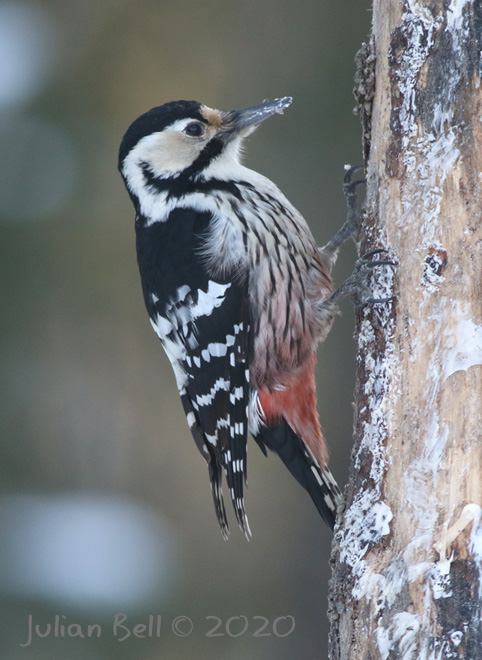
It was not all doom, gloom and death - at Hatten the White-backed Woodpecker hvitryggspett put on a nice show together with a couple of Great-spotted Woodpeckers flaggspett.


Nuthatch spettmeis


White-backed Woodpecker hvitryggspett


Friday, February 05, 2021

Stavanger 01-03 February 2021 - Work trip

 It almost goes without saying that it was cold calm and sunny again - making the work related drive to Stavanger a struggle - driving into low sun throughout.

Even worse was driving past good one good birding spot after another:) It is no wonder the region is the heartland of Norwegian birding.

Just before dark on 01 February a walk out of the hotel through Stavanger city centre to find somewhere to eat saw us pass Breiavatnet - a mostly frozen lake in the middle of town. At least four Moorehen sivhøne and hundreds of Tufted Duck toppand were among the sightings. 

The next day was spent messing around in a small boat in Hillevåg. The first bird to swim past forced me to pick up my camera - a nice Great Crested Grebe toppdykker - a very good bird back home in Øygarden. Coot sothøne, Moorehen sivhøne (both would have been good sightings back home), a few Black-headed Gulls hettemåke and more were seen incidentally during a fun day of multibeam echosounder mayhem.

Great Crested Grebe toppdykker, Hillevåg, Stavanger

Early the next morning a few hundred Starling stær flew over the city centre, no doubt from a roost site somewhere nearby.

Back on the boat at Hillevåg on 03 February it was more of the same with the addition of a female Scaup bergand. It didn't quite "click" in the field and I did consider female tufty at the time. However, I was at work and not birding so I snapped a few pictures and left it that. Looking at the pictures now I see that it could be a hybrid Scaup/Tufted Duck. The bird has a rather dark back to be a Scaup and there is a broad black band to the bill tip which are pro Tufted Duck features. Head shape, the amount of white and the paler cheek patch all point towards Scaup.


Female Scaup bergand (2cy?)


Male Eider ærfugl taking care of some mussels

Mallard stokkand are as stunning as they are common

After a long day on the boat I saw a Snipe enkeltbekkasin fly into Breiavatnet at 2030 in the evening.