Showing posts with label rugde. Show all posts

Sunday, January 25, 2026

Herdlevær 25 January 2026 - A flurry of activity

Another cold and calm day.  My second walk at Herdlevær this year started well but soon went back to something along the lines of same, same. However, stops on the way there and on the way home proved to be quite productive.

Almost the first bird to be seen at Herdlevær was a Kestrel tårnfalk being mobbed by Hooded Crows kråke. Other stuff here included a flock of 11 Fieldfare gråtrost, a Great Northern Diver islom and of course some White-tailed Eagles havørn.

Great Northern Diver islom

After this I did Breivik hoping to find some non-frozen ground which didn't work out well, but the first local Great Spotted Woodpecker flaggspett of the year, an obliging Wren gjerdesmett and small numbers of thrushes were seen.

Wren gjerdesmett
Compared to some previous winters there still seem to be "good" numbers of Wren surviving. Lets hope for mild weather in the immediate future!

Other highlights during the day included a couple of Common Snipe enkeltbekkasin, five Woodcock rugde at three locations, a Water Rail vannrikse and small numbers of Parrot Crossbills furukorsnebb.

I was on my way home with the light fading when I heard about a goose that needed checking out. It was "just" an albifrons Whitefront tundragås but always nice to see and a great find - the bird had been present for "some days".  As  was in the neighbourhood I checked Blomvatnet but this was frozen solid - however, a nice Goshawk hønsehauk made it all worthwhile:)


albifrons Whitefront tundragås at Blomvåg

Robin rødstrupe must also be struggling - but I see some a long way away from any kind of feeding and they seem to be making it so far....

Uber camo - one of the day's five Woodcock rugde. I'm wondering if we should start feeding them - not the kind of weather for this kind of bird at the moment


Øygarden 20-24 January 2026 - A trickle of new species

The weather turned colder, basically calm and sunny but freezing temperatures at least at night.

On 20th January I spent a few hours out in a boat with a couple of friends, there was still too much swell for productive birding in the best places so a few inshore locations were visited. Duck numbers are just a shadow of what they were when I first moved out to Øygarden. Oslofjord gets a lot of attention in the media as it is "dead" (a serious overhype n my opinion) but here in the west things too have also deteriorated alarmingly with no mention of the serious decline in birds and other species. Ling-tailed Duck havelle numbers used to be in the low 100's. These days we are lucky to see over 20 or 30. 

A flock of around 40 Long-tailed Ducks havelle were thus a welcome sight. A lone Velvet Scoter sjøorre, a couple of Common Scoter svartand, a single Curlew storspove and a Black Guillemot teist were in the Tvisloket area along with several White-tailed Eagle havørn.

Heading south past Nautnes and through Langsund was rather quiet bird wise with just a single Common Gull fiskemåke of minor interest. An Oystercatcher tjeld at Alvheim was new for the year and at Solberg a Lapwing vipe flew over - the first for 2026:)

Curlew storspove at Tvisloket - smaller numbers than usual appear to be overwintering here

Heron gråhegre in Alveheimsundet

Flyover Lapwing vipe at Solberg


Long-tailed Ducks havelle, at least at photogenic as Long-tailed tit stjertmeis

An Otter eating a Butterfish (tangsprell). Picture taken from my terrace once I was safely back at work...

One of many White-tailed Eagles havørn seen.

With life returning to normal I only managed a short trip out on 21st January. 

I found a well hidden Woodcock rugde and manged to take a few pictures from a distance without flushing it.  At Tjeldstø I saw my first Rock Pipits skjærpiplerke of the year as well as another Woodcock rugde, a White-tailed Eagle havørn and a flock of Fieldfare gråtrost.

A walk at dusk produced several Woodcock rugde, a Water Rail vannriskse and both Wren gjerdesmett and Robin rødstrupe feeding well past bedtime. The latter was using streetlights to extend its foraging time.

The cold conditions are taking a toll, here a dead Grey Heron gråhegre at a freshwater locality - I'm not sure why this happens as it seems like there is plenty of food in the sea that should be available to the Herons.


Woodcock rugde showing its extremely good camouflage. These pictures were taken at a safe distance without flushing the bird and are heavily cropped. Look for the eye! 

White-tailed Eagle havørn at Tjeldstø

The following day I was barely out of the house. A nice flock of Parrot Crossblls furukorsnebb gave great views after they had quenched their thirst at one of the few available areas of unfrozen water. They did not hang around and I only managed an almost record shot.....

Parrot Crossbill furukorsnebb at Tjeldstø

A Willow Tit granmeis at Hovden was another new species for the year, small numbers of this species have been observed in Øygarden recently.

An extended trip to Skogsøy on 24th was something of an anticlimax with just a Great Northern Diver islom feeding in the bay, a Rock Pipit skjærpiplerke and barely the usual suspects. The drive home produced a couple of Snipe enkeltbekkasin and a Water Rail vannrikse.

Common Snipe enkeltbekkasin


Tuesday, March 19, 2024

Oslo 09-17 March 2024 - Urban Birding

On Saturday 09 March a walk at Bygdøy had a decidedly spring-like feel with flocks of Greylags grågås in the fields, a very vocal Black Woodpecker svartspett, Stock Dove skogdue and Woodpigeons ringdue noted. A flock of nine Purple Sandpipers fjæreplytt at Huk were as always nice to see and a flock of over 50 Oystercatcher tjeld also rested there. Even though the woods were mostly rather quiet it was nice to connect with things like Treecreeper trekryper and Willow Tit granmeis.

The following day I predictably took the boat out to Gressholm where there were more spring vibes in the form of Shelduck gravand and an obvious arrival of Blackbirds svarttrost. Otherwise just the usual Great-crested Grebe toppdykker, Velvet Scoters sjøorre.

The rest of the week was rather hectic at work. On Tuesday all I managed was 20 minutes outside the office at Fornebu which produced a Goshawk hønsehauk as the best bird. Signs of spring here too with displaying Oystercatcher tjeld, Woodpigeon ringdue singing and so on.

Male Goldeneye kvinand at Fornebu

Male Red-breasted Merganser siland at Fornebu

One of several Oystercatcher tjeld outside the office at Fornebu


Displaying Oystercatcher tjeld

On 15 March I took the five minute walk to the Botanical Gardens and was pleasantly surprised by a Grey Wagtail vinterle feeding along the small stream that runs through the gardens - obviously a migrant that has stopped to feed. It was difficult to photograph due to constant disturbance by users of the park. Not a rare bird but this sighting was probably the birding highlight of the week for me.


On Sunday 17 we had a lovely afternoon on Gressholmen in fantastic weather. Hard to choose the best bird among the highlights but a cracking female Lesser-spotted Woodpecker dvergspett was absolutely among them. Other nice sightings included three Woodcock rugde - seemingly the first in Oslo this year and a number of other new species for the island this year.


Female Lesser-spotted Woodpecker dvergspett on Gressholmen


Saturday, January 28, 2023

Skogsøy 28 January 2023 - A trickle of movement

Relatively light NW winds and sunny.

I headed out to Skogsøy and spent an hour sewatching - unsurprisingly rather quiet but a Razorbill alke heading south was new for the year as were a few Kittiwake krykkje. A single Gannet havsule headed south. The only noticeable migration were several pairs of GBBG svartbak heading north.

A walk at Breivik was also rather quiet but eight Tree Sparrow pilfink were the first I've seen in Øygarden this year and a flock of six Parrot Crossbill furukorsnebb were busy with pine cones. A flock of four Curlew storspove fed in the fields here too.

One of the better birds seen today was a Woodcock rugde at Nautnes as I set off for the morning. Good to see so many have survived the two cold spells we have had thus far this winter. Fingers crossed for a continued period of mild weather:)

Using automatic settings on the new point and pray

Underexposing in an attempt to increase the shutter speed gave a more realistic feel with regards to lighting and the experience


Saturday, February 06, 2021

Øygarden 04-05 February 2021 - A killer winter

 This cold and sunny weather should f*** off back to the east of Norway where it belongs. The longest spell of cold weather for years is now taking a heavy toll on the species that normally manage to survive our usual winters. The Snipe enkeltbekkasin and Woodcock rugde seemed to manage quite well for a few weeks but now they are succumbing to the relentless frozen conditions.

On 04 February I didn't do much other than a very quick look at a part of Tjeldstø where I had a Woodcock rugde, a Sparrowhawk spurvehauk and a couple of White-tailed Eagle havørn.

A roadside Dipper fossekall found plenty of food, catching new prey after only a few seconds underwater. Quite possibly because this species is not normally present so there is plenty to eat for the few birds that do turn up. No worries dealing with the cold for this bird:)

Dipper fossekall with prey

Back home at Nautnes a Greylag grågås headed south, no doubt fleeing the frozen and snow covered fields in search of somewhere milder. Another Woodcock rugde here too - I hoped that it would follow the lead of the Blackbirds svarttrost and try to find food along the shore but this proved not to be the case.

Female Goldeneye kvinand on the sea in front of my house

On 05 February I did Herdlevær before heading home to work. One dead Woodcock rugde and one flying over, a Snipe enkeltbekkasin that had died very shortly before I found it (although it has frozen into the ice it was not yet frozen itself). Although I am staying away from the best areas that are most likely to be able to support such species this one was in a tiny and unexpected area of unfrozen ground.

A Snipe enkeltbekkasin that had died of cold and starvation only a short time before I found it - still trying to find something to eat to the very last....

Birds that were still alive included a Black Guillemot teist, a Red-throated Diver smålom, a flock of 13 Goldeneye kvinand, a few White-tailed Eagle havørn and a flock of 60-70 Eider ærfugl feeding offshore.

More Woodcock rugde both dead and alive were seen on the way home - one of the dead ones included the bird I saw yesterday at Nautnes.

Woodcock rugde hoping that the ground might thaw in this sunny spot

One of a few dead Woodcock rugde seen today. I did not go nearer in case there were others hiding nearby

It was not all doom, gloom and death - at Hatten the White-backed Woodpecker hvitryggspett put on a nice show together with a couple of Great-spotted Woodpeckers flaggspett.


Nuthatch spettmeis


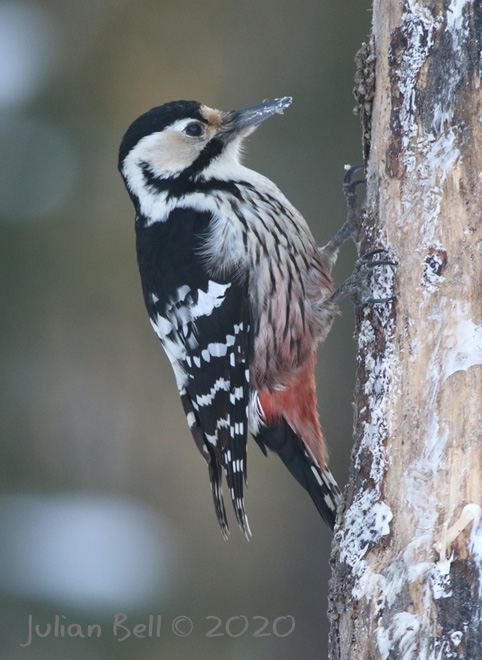
White-backed Woodpecker hvitryggspett


Saturday, January 16, 2021

Herdlevær 14 January 2021 - Slav

 Calm and frozen.

I did my usual round at Herdlevær in between working from home. Best bird was a nice Slavonian Grebe horndykker - a species I have looked for a few times already this year without success. Other sightings of interest were a coupe of Woodcock rugde, a Snipe enkeltbekkasin, a flock of 20 Greylags grågås that looked like they went in for landing in the Breivik/Kollsnes area but were not seen on the way home, a couple of Redwing rødvingetrost and a bunch of other new species for the year for this locality.

Slavonian Grebe horndykker at Herdlevær

Back home a Woodcock rugde gave cracking views from the car at the end of my driveway - it believed itself invisible and did not fly, a Redpoll gråsisik flew over (few and far between this winter) and the Blackbird svarttrost flock showed no signs of diminishing - they are eating me out of house and home at the moment.

Woodcock rugde