Showing posts with label Lapwing. Show all posts

Sunday, January 25, 2026

Øygarden 20-24 January 2026 - A trickle of new species

The weather turned colder, basically calm and sunny but freezing temperatures at least at night.

On 20th January I spent a few hours out in a boat with a couple of friends, there was still too much swell for productive birding in the best places so a few inshore locations were visited. Duck numbers are just a shadow of what they were when I first moved out to Øygarden. Oslofjord gets a lot of attention in the media as it is "dead" (a serious overhype n my opinion) but here in the west things too have also deteriorated alarmingly with no mention of the serious decline in birds and other species. Ling-tailed Duck havelle numbers used to be in the low 100's. These days we are lucky to see over 20 or 30. 

A flock of around 40 Long-tailed Ducks havelle were thus a welcome sight. A lone Velvet Scoter sjøorre, a couple of Common Scoter svartand, a single Curlew storspove and a Black Guillemot teist were in the Tvisloket area along with several White-tailed Eagle havørn.

Heading south past Nautnes and through Langsund was rather quiet bird wise with just a single Common Gull fiskemåke of minor interest. An Oystercatcher tjeld at Alvheim was new for the year and at Solberg a Lapwing vipe flew over - the first for 2026:)

Curlew storspove at Tvisloket - smaller numbers than usual appear to be overwintering here

Heron gråhegre in Alveheimsundet

Flyover Lapwing vipe at Solberg


Long-tailed Ducks havelle, at least at photogenic as Long-tailed tit stjertmeis

An Otter eating a Butterfish (tangsprell). Picture taken from my terrace once I was safely back at work...

One of many White-tailed Eagles havørn seen.

With life returning to normal I only managed a short trip out on 21st January. 

I found a well hidden Woodcock rugde and manged to take a few pictures from a distance without flushing it.  At Tjeldstø I saw my first Rock Pipits skjærpiplerke of the year as well as another Woodcock rugde, a White-tailed Eagle havørn and a flock of Fieldfare gråtrost.

A walk at dusk produced several Woodcock rugde, a Water Rail vannriskse and both Wren gjerdesmett and Robin rødstrupe feeding well past bedtime. The latter was using streetlights to extend its foraging time.

The cold conditions are taking a toll, here a dead Grey Heron gråhegre at a freshwater locality - I'm not sure why this happens as it seems like there is plenty of food in the sea that should be available to the Herons.


Woodcock rugde showing its extremely good camouflage. These pictures were taken at a safe distance without flushing the bird and are heavily cropped. Look for the eye! 

White-tailed Eagle havørn at Tjeldstø

The following day I was barely out of the house. A nice flock of Parrot Crossblls furukorsnebb gave great views after they had quenched their thirst at one of the few available areas of unfrozen water. They did not hang around and I only managed an almost record shot.....

Parrot Crossbill furukorsnebb at Tjeldstø

A Willow Tit granmeis at Hovden was another new species for the year, small numbers of this species have been observed in Øygarden recently.

An extended trip to Skogsøy on 24th was something of an anticlimax with just a Great Northern Diver islom feeding in the bay, a Rock Pipit skjærpiplerke and barely the usual suspects. The drive home produced a couple of Snipe enkeltbekkasin and a Water Rail vannrikse.

Common Snipe enkeltbekkasin


Monday, November 14, 2022

Øygarden 06-11 November 2022 - November:)

November is one of my favourite months as although the main migration may be over there is always something to see and it often a time for things that may be common elsewhere to turn up.

I arrived home as the light was going on 06 November and just had to pop across to Sæle, just in case "something" might have lingered on. This was not the case but a couple of Bullfinch dompap (never common here but a typical early November migrant), some Blackcaps munk, a few Chiff-chaff gransanger and a Rook kornkråke along with the usual thrushes, Robins rødstrupe etc meant that it wasn't waste of time.


Chiff-chaff gransanger - this one was calling like a normal one

Rook kornkråke, a scarce but annual visitor in early spring and late autumn

The following day I was back there again for an hour or so - hoping to turn one of the Chiff-chaff into a tristis. This was also not the case but a Long-tailed Tit stjertmeis and a Willow Tit granmeis put in an appearance amongst the Blackcaps munk, Chiff-chaffs gransanger, Goldcrests fuglekonge and other migrants present. Plenty going on so it was most enjoyable.


Chiff-chaffs gransanger at Sæle

Long-tailed Tit stjertmeis


A very short visit to Herdlevær on 08 November produced a very vocal tristis Chiff-chaff sibirgransanger, a Woodcock rugde, a Willow Tit granmeis, a flock of six Waxwing sidensvans, a Goldfinch stillits and plenty of commoner migrants.

On the way home I picked up a couple of lateish Meadow Pipits heipiplerke at Breivik and a Lapwing vipe at Tjeldstø.


Crested Tit toppmeis at Herdlevær

Lapwing vipe at Tjeldstø

Three of six Waxwing sidensvans at Herdlevær

A morning visit to Hellesøy on 09 November gave a Waxwing sidensvans and a Merlin dvergfalk as highlights.

On the way home a couple each of Goldfinch stillits and Goldcrest fuglekonge were the only things of interest but plenty of Redwing rødvingetrost and Blackbird svarttrost about. Sæle gave up the same as the previous visits with Long-tailed Tit stjertmeis, Blackcaps munk and Chiff-chaffs gransanger still around. 

It was here disaster struck - my trusty DSLR gave up the ghost. I thought it was my lens that was on the way out but the camera itself refused to take pictures. Yet another one bites the dust and puts me in a predicament....

Next up was a female Scaup bergand at Husvatnet, without a camera there were no pictures...

Back home a Redpoll gråsisik and a couple of Tree Sparrow pilfink joined the more usual selection of species in the garden

There was no time to get out of the house on 10 November, though a trip to the shops in the late afternoon produced an unusual sighting in the form of a Fulmar havhest swimming amongst the boats at Rong and the Lapwing vipe a Tjeldstø was still present along with the Scaup bergand.


Fulmar havhest, either sick or exhausted at Rong.
Unusual place and time of year, this bird swam in among the small boats tied up along the quayside

On 11 November I did no birding at all, but drove into Bergen for a lovely couple of hours with my youngest and a quick visit to a camera shop. More about the latter later....


Monday, July 06, 2020

Øygarden 03-05 July 2020 - Time to get a hunting license.....

Spending most of my time trying to get caught up with house stuff, sawing and splitting logs etc, but still out and about to a certain degree most days.

The Rosy Starling rosenstær has predictably proved popular with twitchers from town and has been seen daily since I found it - although disappears for long periods of time.

I finally made the effort to catch up with a Wryneck vendehals pair that are breeding in a nestbox having ousted the previous occupants.

During wet weather on 05 July I checked out a few localities. The Common Tern makrellterne colony at Dåvøy remains abandoned - although I am not certain it would be easy to point the finger at mink being the reason behind this. However, a small Arctic Tern rødnebbterne colony surprisingly remains active at Tjeldstø with adults coming in with food regularly. At least one pair of Common Tern were among these.

Arctic Terns rødnebbterne with young


The Common Tern pair at Nautnes have a well grown chick but it is not yet on the wing. There have been only a couple of pairs at this locality - so it is puzzling that these have got so far whilst a larger colony has failed......

Some Lapwings vipe have fully fledged young - it seems the birds at Kollsnes may have managed to raise some young and moved over to better feeding at Breivik where another pair probably has very small young. At Breivik a Woodcock rugde flew over despite it being the middle of the day.


This adult was actively warning some young hidden in the grass at Breivik

One of the Lapwing chicks at Husvatnet, Tjeldstø - only a few tens of metres from a hunting mink

At Tjeldstø there was at least one Lapwing chick - seems to be growing fast and hopefully it will be fast enough. Just after I photographed this agitated Common Gulls fiskemåke drew my attention to a mink obviously looking for eggs or chicks in the reserve. Without my dog I am now evaluating going through the process of obtaining a hunting license so I can shoot these things....

Wish it was something other than a camera I shot this with......


Saturday, May 30, 2020

Tjeldstø 24 May 2020 - Marsh Harrier blunder

Light rain and lighter winds provided better conditions for bringing "something" in.

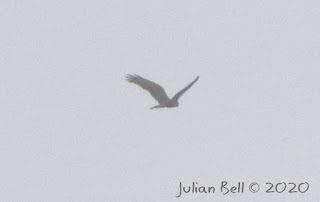
And today that something was a cracking female Marsh Harrier sivhauk that came past at point blank range as I got back into my car at Tjeldstø. I turned for my camera only to find it was still in my rucksack. What a blunder! One day I will have to learn that the camera is no use in the rucksack. By the time I extracted the camera the bird had gained height and was heading south over the reserve. This is the 11th find of this species in Øygarden.


Female Marsh Harrier sivhauk mobbed by Hooded Crows kråke

Marsh Harrier occurrence by week number in Øygarden (from artsobs)

A Merlin dvergfalk also put in an appearance at Tjeldstø.

Common Whitethroat tornsanger at Tjeldstø

Golden Plover heilo

Meadow Pipit heipiplerke at Kollsnes


Lapwing vipe at Kollsnes


Other than that it was very much business as usual during a quick round of localities.


Thursday, January 30, 2020

Tjeldstø and Breivik 30 January 2020 - Spring

Cool SE breeze and overcast, some light drizzle

Brambling bjørkefink and Chaffinch bokfink

Just part of a mixed flock of Bramblings and Chaffinch at Tjeldstø, with a single Fieldfare gråtrost sneaking into shot.


At Tjeldstø there was a good flock of 44 Fieldfare gråtrost feeding in the fields  - with them a lone Redwing rødvingetrost and a couple of Starling stær. Also here, and also feeding on the ground, were at least 40 Brambling bjørkefink and around 30 Chaffinch bokfink - good sized flocks for both species out here in winter. Such flocks feeding on the ground are more often associated with spring arrivals.

The first Lapwing vipe of the year

Breivik only heightened the sense of spring with the first Lapwing vipe of the year and a flock of eight Starling stær indicating an arrival from somewhere. A single Snipe enkeltbekkasin was more expected along with White-tailed Eagle havørn, Raven ravn etc.