Showing posts with label albifrons. Show all posts

Sunday, April 19, 2026

Øygarden 02-07 April 2026 - Happy Easter:)

A week back home which included a few days off around Easter was quite productive even though I took things pretty easy - normally I would have done more at Skogsøy but time just did not permit.

On 2nd April the female aythya that has been here and there in northern Øygarden since early February allowed for some better views and finally swung me over to Scaup bergand despite seeming to have rather a lot of black on the beak.

2cy female Scaup bergand

The usual round at Herdlevær gave White Wagtail linerle, Red-throated Diver smålom, White-tailed Eagles havørn, a Meadow Pipit heipiplerke and a variety of other migrants. Tjeldstø produced another Red-throated Diver smålom, some Gannets havsule feeding in the fjord and the usual. My first Chiff-chaff gransanger of the year fed at Sture.


In the afternoon a Pinkfoot kortnebbgås and an albifrons Whitefront tundragås were reported, I managed to hear the former among Greylags grågås and see the latter briefly in flight.

I started the 3rd April at Hjelme where a Chiff-chaff gransanger and a Grey-headed Woodpecker gråspett were the best sightings.

Grey-headed Woodpecker gråspett

At Sæle a Red necked Grebe gråstrupedykker on the sea was probably the same bird that has been reported on and off at this locality previously. Small numbers of Long-tailed Duck havelle, a Common Scoter svartand, Black Guillemot teist and singles of both Rock Pipit skjærpiplerke and Meadow Pipit heipiplerke fed in the area.

Next stop was Tjeldstø where the Scaup bergand showed quite well again. A rarer sightig for northern Øygarden were two of last year's Mute Swans knoppsvane - almost certainly of urban origin as they swam straight over to me when I got out of the car. Several Teal krikkand, a couple of White Wagtails linerle and a Meadow Pipit heipiplerke were indications that migration is picking up.


Breivik proved quite productive with the first Jackdaw kaie of the year, a pair of Stonechat svartstrupe and the first two Linnets tornirisk of the year.

Common Gulls fiskemåke feeding at Breivik


The first Linnets tornirisk of 2026

Saturday 4th April was quite social as I bumped into a number of other birders out and about. Although it was a nice morning out and about nothing special was seen. The female Scaup bergand and the two young Mute Swans knoppsvane remained at Husvatnet, Tjeldstø.

Crested Tit toppmeis photographed at a feeding station

The 5th produced a flurry of new arrivals starting with a Dunnock jernspurv in my garden. Numbers of singing Song Thrush måltrost and Redwing rødvingetrost increased too.

At Husvatnet, Tjeldstø the first Redshank rødstilk of the year put in an appearance. Breivik was quite good with a nice Ring Ousel ringtrost and the albifrons Whitefront tundragås as the best observations. The Stonechat svartstrupe pair at Kollsnes showed well too:)

Redshank rødstilk at Husvatnet

Ring Ousel ringtrost at Breivik


Stonechats svartstrupe at Kollsnes

Albifrons Whitefront tundragås at Breivik


The two Mute Swans knoppsvane had moved to Dåvøy and it was here that I noticed they were colour ringed. Both birds were ringed last autumn further south in Øygarden at Stølsneset, Ågotnes - so these Easter tourists had not moved very far from their ringing site.


Mute Swans knoppsvane at Dåvøy


I actually left Øygarden on 7th April and did a guding trip at Herdla. There was plenty to be seen here including White-tailed Eagles havørn, a few Pinkfeet kortnebbgås, a Barnacle Goose hvitkinngås, a couple of Golden Plover heilo and a Pied Wagtail svartryggerle along with good numbers of Lapwing vipe, Ringed Plover sandlo, Meadow Pipits heipiplerke and the usual.

A Common Snipe enkeltbekkasin at Ådnevika was undoubtedly a new arrival as it has been a while since the overwintering birds have shown. On the way home the albifrons Whitefront tundragås showed well at Breivik.


Albifrons Whitefront tundragås


Curlews storspove also returned during this period and it was lovely to hear them displaying at several localities in northern Øygarden.


Sunday, January 25, 2026

Herdlevær 25 January 2026 - A flurry of activity

Another cold and calm day.  My second walk at Herdlevær this year started well but soon went back to something along the lines of same, same. However, stops on the way there and on the way home proved to be quite productive.

Almost the first bird to be seen at Herdlevær was a Kestrel tårnfalk being mobbed by Hooded Crows kråke. Other stuff here included a flock of 11 Fieldfare gråtrost, a Great Northern Diver islom and of course some White-tailed Eagles havørn.

Great Northern Diver islom

After this I did Breivik hoping to find some non-frozen ground which didn't work out well, but the first local Great Spotted Woodpecker flaggspett of the year, an obliging Wren gjerdesmett and small numbers of thrushes were seen.

Wren gjerdesmett
Compared to some previous winters there still seem to be "good" numbers of Wren surviving. Lets hope for mild weather in the immediate future!

Other highlights during the day included a couple of Common Snipe enkeltbekkasin, five Woodcock rugde at three locations, a Water Rail vannrikse and small numbers of Parrot Crossbills furukorsnebb.

I was on my way home with the light fading when I heard about a goose that needed checking out. It was "just" an albifrons Whitefront tundragås but always nice to see and a great find - the bird had been present for "some days".  As  was in the neighbourhood I checked Blomvatnet but this was frozen solid - however, a nice Goshawk hønsehauk made it all worthwhile:)


albifrons Whitefront tundragås at Blomvåg

Robin rødstrupe must also be struggling - but I see some a long way away from any kind of feeding and they seem to be making it so far....

Uber camo - one of the day's five Woodcock rugde. I'm wondering if we should start feeding them - not the kind of weather for this kind of bird at the moment


Sunday, February 09, 2025

Øygarden 02.02-09.02.2025 -

On 2nd February I did my usual round at Herdlevær, not much to report at all, although five White-tailed Eagle havørn feeding there and several Gannet havsule heading north during a brief coffee break. The albifrons Whitefront tundragås remained at Breivik. On the way home again a short stop at Tjeldstø produced my first local Goshawk hønsehauk of the year and later on I picked up three Snipe enkeltbekkasin at Hjelme.

The next day I was snowed under with work and only managed the briefest of drive-bys. A Common Seal steinkobbe at Dåvøy and a small flock of Goldfinch stillits in the garden along with the usual White-tailed Eagles havørn were all that I managed to see.


Common Seal steinkobbe at Dåvøy

The 4th February was only slightly better with an hour or so out of the house. A couple of Velvet Scoter sjøorre near Tjeldstø and the long-staying albifrons at Breivik were the only sightings of note.

albifrons Whitefront tundragås at Breivik

I spent 20 minutes at Hellesøy on 5th February without anything unusual being seen. Several each of Black Guillemot teist and Long-tailed Duck havelle and a few White-tailed Eagle havørn were among the birds seen here.

A tip-off regarding a Golden Eagle kongeørn later in the day had me leaving the house at short notice. Although there were signs of it's presence (flocks of gulls and crows flying around in disarray) it initially proved difficult to locate. I connected with it over Dåvøy where it headed back to Staumsundet. A small flock of Starling stær at Tjeldstø and a single at Skjold may well have been returning birds. Shortly after this I had to leave for a work trip.

Little Grebe dverdykker at Dåvøy

I returned late on Friday 7th February and did some birding the the next day. I started at Herdlevær which was fairly quiet, though I did pick up a Little Auk alkekonge there along with a single COmmon Scoter svartand (very scarce this winter) and a couple of Eiders ærfugl. Four Purple Sandpiper fjæreplytt, a small flock of Siskin grønnsisik and several very vocal Crested Tits toppmeis were among the other species seen here. A flock of 16 Starling stær near the car park were almost definitely new arrivals.


Purple Sandpipers fjæreplytt at Herdlevær


On Sunday 9th February I headed to Hjelme West under ideal conditions. Before I left the house round 150 Siskin grønnsisik headed south over my terrace in flocks of between 20 and 40. The woods at Hjelme were full of Siskin grønnsisik with smaller numbers of Redpoll gråsisik, Common Crossbill grankorsnebb and the usual suspects. The sea and islands were quite good in a recent perspective with a few Great Northern Diver islom, reasonable numbers of Black Guillemot teist (8+), a Red-throated Diver smålom, a Curlew storspove, a few Oystercatcher tjeld, 30+ Purple Sandpiper fjæreplytt and a Turnstone steinvender among the sightings. Long-tailed Duck havelle numbers were horribly low (17) with just an Eider ærfugl or two as the only other ducks.

A Goshawk hønsehauk hunting past my terrace was the first I've seen from my house this year. At Tjeldstø there was a noticeable arrival of Greylags grågås - probably returning birds.


Monday, April 29, 2024

Herdlevær and Tjeldstø 28 April 2024 - Taking things easy pays off

After some weeks of little physical activity it was time to let my body recover a bit - 0430 starts and the hike out to Skogsøy with a heavy rucksack is a good way to stay more or less in shape but after only two days I could feel it. I also thought that it would be a quiet day over the sea with the third day in a row of identical weather conditions - and there are other places than need some coverage.

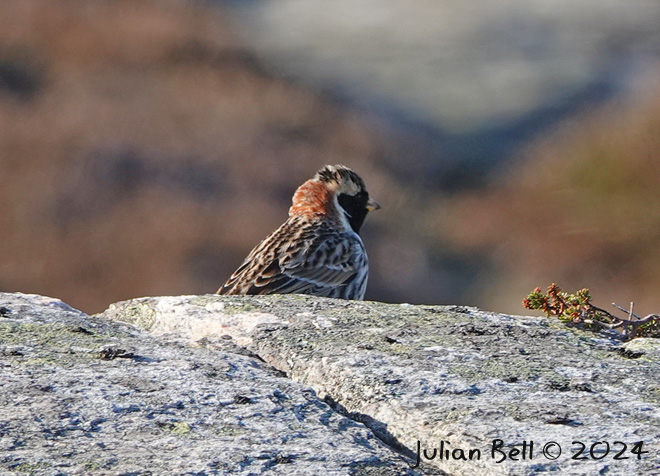
So I stayed in bed until 0700 and took a lazy walk at Herdlevær. Before I left the house I heard the first Cuckoo gjøk of  the year. Herdlevær turned out quite well with a cracking male Lapland Bunting lappspurv, a couple of Blackcap munk, a few Willow Warbler løvsanger and two Chiff-chaff gransanger among the sightings. A few Twite bergirisk, a noticeable increase in the numbers of Wheatear steinskvett and more meant this was a decent start to the morning.


Lapland Bunting lappspurv at Herdlevær

My plan was to have a look at the much neglected Tjeldstø on the way home, something that really paid off. An albifrons Whitefront tundragås had been found there earlier in the morning and was still present when I got there  - in the company of a couple of Greenshank gluttsnipe - both species are scarce in Øygarden during the spring. But my real reason to visit Tjeldstø was to have a look for some raptors. It didn't take long before a male Marsh Harrier sivhauk showed up. The Golden Eagle kongeørn put in an appearance and at least three White-tailed Eagle havørn showed up. A flock of 20 cracking summer plumaged Golden Plover heilo joined the usual selection of breeding waders in the reserve.


Some record shots of the Marsh Harrier sivhauk

albifrons Whitefront tundragås

Whitefront on the right and two Greenshank gluttsnipe just visible on the left

Marsh Harrier sivhauk is not even annual in Øygarden but has a definite peak in late April/early May. It is likely to be under recorded as most birders including myself tend to concentrate on seabird migration at this time

Wednesday, February 14, 2018

Breivik 11 February 2018 - Back to winter again

Snowing.

I was out of the house for about 45 minutes all in today and thought I would check if any more geese had arrived after yesterday's Greylag grågås arrival. I found four albifrons Whitefronts tundragås at Breivik but that was it - probably the same birds I have seen in the area for the last week or so.

albifrons Whitefronts tundragås

A cooperative Snipe enkeltbakkasin was another of the sightings today

Friday, February 02, 2018

Øygarden 31.01 - 02.02.2018 - Bits and bobs

Fieldfare gråtrost

Redwing rødvingetrost


Part of the Fieldfare gråtrost flock feeding in the snow

Three of the four albifrons Whitefronts tundragås


Rain and snow on the last day of January combined with a heavy workload meant I limited things to a drive-by at Tjeldstø. Plenty of thrushes feeding in the fields and four albifrons Whitefront tundragås at Harkestad were pretty much the only sightings.


Crested Tit toppmeis - a common woodland bird that I don't tend to photograph very much

Tufted Duck toppand

Whitefront tundragås

I try not to take too many White-tailed Eagle havørn photographs but it would have been downright rude to ignore this poser


February started with very nice conditions indeed - calm and sunny with some frost. A quick trip out to Hjelme Vest produced pretty much the usual with a few Great Northern Divers islom, a couple of Kittiwake krykkje feeding, a few Black Guillemots teist and several White-tailed Eagles havørn among the sightings. Long-tailed Duck havelle now up to more than 40 birds - pathetic numbers compared to relatively few years ago.

An aythya duck at Husvatnet fooled me for a while and needed closer inspection - it turned out to be a Tufted Duck toppand. However, the effort was not wasted as some Whitefronts tundragås flew in right over my head.

Parrot Crossbill furukorsnebb weightlifting

Razorbill alke

A quick walk at Skogsøy in stunning conditions on 2nd February gave little out of the ordinary - at least three White-tailed Eagle havørn, a Great Northern Diver islom and a massive eight Gannet havsule heading north. A Razorbill alke was feeding close in and some Parrot Crossbills furukorsnebb put in an appearance.