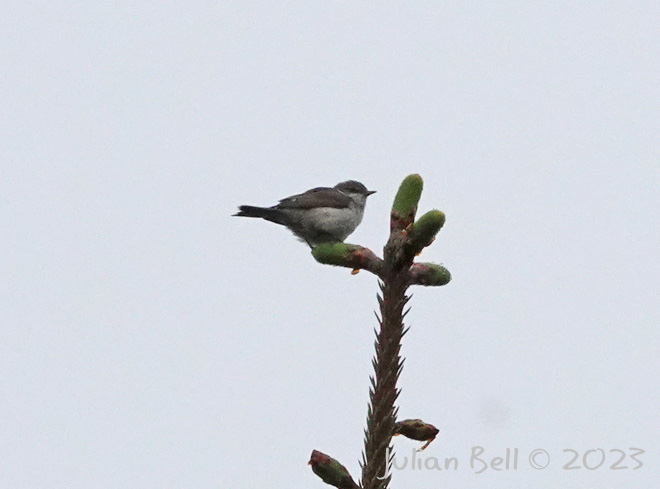
A week spent in my inland home away from home:) I managed to cover most of my usual spots in between work and other stuff.
My impression was that things were a lot quieter than normal for this time of year. Waders were rather thin on the ground - very small numbers of Whimbrel småspove compared to normal, most tringa waders well down on normal numbers and a some of species of wader were simply not present. Yellow wagtail gulerele, normally extremely common, were present in much lower numbers than usual. Perhaps this is due to the fact that the spring was rather late and there was a long period of cold weather that stopped just a couple of days before I arrived.
That said, a decent variety of species (at least 82) were seen including a couple more new Engerdal species for me - a Hawfinch kjernebiter in the garden and a female Hen Harrier myrhauk. Other highlights including breeding Short-eared Owl jordugle, excellent views of singing Icterine Warbler gulsanger, Common Buzzard musvåk and Great Grey Shrike varsler seemingly holding territory.
Hawfinch kjernebiter - a new species for me in Engerdal.
This bird was seen in the garden at Heggriset.
Female Hen Harrier myrhauk - another new species for me in Engerdal - one of the first birds seen on my "farewell tour" on the morning I left.
Common Buzzard musvåk, Heggeriset
This shot shows the effect of the light with one pupil much larger than the other one:)
Short-eared Owl jordugle.
There was quite a lot of evidence of rodents in the hills, Kestrels tårnfalk were pretty much everywhere so it seems like not too bad a year for these birds in the mountains
Great Grey Shrike varsler - normally I see this species in the autumn / winter but they also breed in the area. Another pointer towards a reasonable rodent year higher up.
Icterine Warbler gulsanger - this bird at Heggeriset and another at Galten were the only two I saw during the week in Engerdal.
A couple of unseasonal sightings at Drevsjø were a flyover Jackdaw kaie and a Starling stær which looked like it was visiting a nest hole - this is a species I have normally seen as an autumn migrant in Engerdal.
Common Tern makrellterne at Sorken.
Arctic Tern rødnebbterne is the commonest tern in Engerdal
Yellow Wagtail gulerle at Heggeriset
This species was noticeably less numerous than normal this time round
Bullfinches dompap with young were still visiting the garden feeder
Great-spotted Woodpecker flaggspett, Engerdal
Siskin grønnsisik at the feeder
Bullfinch dompap at Heggeriset
Merganser siland, Galten
Raven ravn, near Drevsjø
Brambling bjørkefink - one of the commonest breeding birds in Engerdal
Heading east I had to stop for a meeting and what better place than Halne on the Hardangervidda:)
After work I had a couple of short walks in the area, still some snow around and the lake was mostly covered in ice. Best bird in a Hardangervidda context was a Black-throated Diver storlom which fed briefly on an ice free area. Otherwise it was more or less situation normal, or perhaps the "new normal" as I did not see any Lapland Bunting lappsourv.
Singing Bluethroat blåstrupe and Shorelark fjelllerke, displaying Rock Ptarmigan fjellrype and a selection of the usual waders were among the sightings here.
Another day, another seawatch. With work and personal trips coming up it was time for the last seawatch of the loonatic season.
Nothing remarkable noted but given the time of year there was plenty going on:) Frustratingly a number of wader flocks passed just too far out to clinch ID.
Gannets havsule
Kittiwake krykkje
Above and below: Puffins lunde
Razorbills alke
Red-throated Diver smålom
Shag toppskarv
White-billed Diver gulnebblom
Red throated Diver smålom N 35, S 1
White Billed Diver gulnebblom N2 (adult)
Northern Gannet havsule N 69, S 5
Great Cormorant storskarv N1, S 2
Eurasian Shag toppskarv N 18, S 19
Common Scoter svartand S2
Merganser siland N5
Golden Plover heilo N1
Whimbrel småspove N1
Redshank rødstilk N 1
Common Gull fiskemåke N33
Lesser black backed Gull sildemåke N8
Herring Gull gråmåke N1
Black-legged Kittiwake krykkje N4
Arctic Tern rødnebbterne N32, S 2
Common Tern makrellterne N 1
Common Guillemot lomvi N3, S 1
Razorbill alke N23
Atlantic Puffin lunde N4, S 1
Auk N14, S 8
On the way home I picked up a Carrion Crow svartkråke at Breivik. Such a tedious rarity but I dutifully took some pictures and even a video for documentation.
Carrion Crow svartkråke at Breivik
The long-staying Whooper Swan sangsvane put in an appearance on Husvatnet where the unseasonal Tufted Ducks toppand remained. Could young tufties be turning up in a month or two I wonder....
Took things easy with just a relatively late and lazy round at Herdlevær.
Work seems everywhere and today was no exception - the Edda Flora was working close inshore close to Kollsnes.
Work is never far away.... Edda Flora working close to Kollsnes
Once again it looked like I should really have been at Skogsøy as there was decent passage at what passes for good range at Herdlevær - no doubt things would have been better at my favoured seawatching spot:)
Starling stær with newly fledged young were a feature today, a Curlew storspove seems to be managing thus far and was chasing off crows and gulls. A strange find was a dead female Merganser siland - no idea how this happened.
Dead female Red-breasted Merganser - siland. No clue what this bird died of and although a common species all year round in Øygarden it is not one I find dead very often.
Between 0850 and 0950 I had two dark phase Arctic Skua tyvjo, 41 Red-throated Diver smålom, 9 Razorbill alke, 7 Kittiwake krykkje, a lone Brent Goose ringgås and a few Ringed Plover sandlo. A further eight Ringed Plover rested on the shore.
On the way home I checked out the tern colony at Dåvøy, all seemed well there and there were several pairs of Arctic Terns rødnebbterne among the more numerous Common Terns makrellterne. Oystercatchers tjeld and other species obviously also breeding in the area - a fact also noted by my pet hate - cats. One was trying to get Oystercatchers along the shore.....
Cat hunting along the shore at Dåvøy. This picture also illustrates the huge amount of plastic that comes in on the sea. Both cats and plastic are major threats to breeding birds in the area.
With a fresh northerly wind blowing the only real choice was Skogsøy. At this time of year it is often a case of quality rather than quantity - today was more a case of variation with quite a number of species passing including a couple of Arctic Skua tyvjo, a flock of Sanderling sandløper, a lone Brent Goose ringgås, a Black.-throated Diver storlom, a small flock of Long-tailed Duck havelle and a 2cy White-billed Diver gulnebblom heading north. A flock of 9 Barnacle Geese hvitkinngås flew south along with a Shelduck gravand - nice that autumn migration is underway already:)
Black-throated Diver storlom
Experience has shown that this species often flies faster than the much commoner Red-throated Diver smålom. Illustrated in this pictures where it rapidly overtook its smaller relative.
On the way home six Black-tailed Godwit svarthalespove were present on Husvatnet, Tjeldstø. Previous max this week was four:)
Four Black-tailed Godwits svarthalespove at Tjelstø earlier in the week
Lesser Whitethroat møller still very obvious and singing "everywhere"
Earlier in the week I wasn't out that much but two pairs of Tufted Duck toppand on Rotevatnet may be worth following - not often Tufties are around this late and the habitat is quite suitable:)
Lots of young birds about with a couple more Lapwing vipe families out and about and of course the increasing numbers of Greylags, UK9 is still hanging around with what I presume is a flock of non-breeding birds.