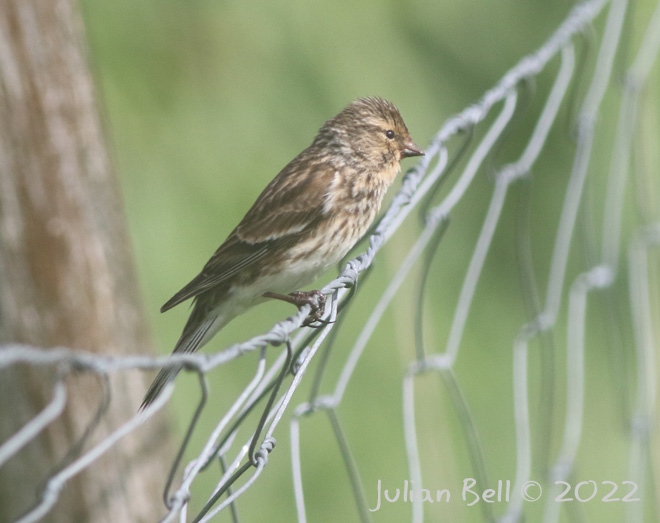
No birding activity on 16 May though I did pick up my first Whinchat buskskvett of the year during a drive-by at Breivik.
Linnet tornirisk at Breivik
On Norway's national day I did my usual round at Herdlevær and saw a decent selection of migrants and newly arrived breeders. Best bird was a singing Icterine Warbler gulsanger. A couple of Shelduck gravand heading south, six White-tailed Eagles havørn, a Whimbrel småspove, singing Blackcap munk and Lesser Whitethroats møller, a Skylark sanglerke heading south and a couple of Twite bergirisk were among the sightings.
Icterine Warbler gulsanger at Herdlevær
Some of the White-tailed Eagles havørn present
A female Mallard stokkand at Kollsnes had 11 young.
Having spent Thursday seawatching in order to meet the regulars I was "forced" to do Hernar on Friday instead. Others had been out on Thursday and nailed a bunch of new species for the island this year. However, even more was present during my visit with highlights being a singing Wryneck vendehals and a VERY early and silent Icterine Warbler gulsanger.
The supporting cast included a Pied Flycatcher svarthvit fluesnapper, several Blackcap munk, three Shelduck gravand flying over, Cuckoo gjøk, several each of Willow Warbler løvsanger and Chiff-chaff gransanger, a Lesser Whitethroat møller and a Common Whitethroat tornsanger.
Lesser Whitethoat møller
Wryneck vendehals
Other stuff off the island included a displaying Black Grouse orrfugl.
A week spent in my inland home away from home:) I managed to cover most of my usual spots in between work and other stuff.
My impression was that things were a lot quieter than normal for this time of year. Waders were rather thin on the ground - very small numbers of Whimbrel småspove compared to normal, most tringa waders well down on normal numbers and a some of species of wader were simply not present. Yellow wagtail gulerele, normally extremely common, were present in much lower numbers than usual. Perhaps this is due to the fact that the spring was rather late and there was a long period of cold weather that stopped just a couple of days before I arrived.
That said, a decent variety of species (at least 82) were seen including a couple more new Engerdal species for me - a Hawfinch kjernebiter in the garden and a female Hen Harrier myrhauk. Other highlights including breeding Short-eared Owl jordugle, excellent views of singing Icterine Warbler gulsanger, Common Buzzard musvåk and Great Grey Shrike varsler seemingly holding territory.
Hawfinch kjernebiter - a new species for me in Engerdal.
This bird was seen in the garden at Heggriset.
Female Hen Harrier myrhauk - another new species for me in Engerdal - one of the first birds seen on my "farewell tour" on the morning I left.
Common Buzzard musvåk, Heggeriset
This shot shows the effect of the light with one pupil much larger than the other one:)
Short-eared Owl jordugle.
There was quite a lot of evidence of rodents in the hills, Kestrels tårnfalk were pretty much everywhere so it seems like not too bad a year for these birds in the mountains
Great Grey Shrike varsler - normally I see this species in the autumn / winter but they also breed in the area. Another pointer towards a reasonable rodent year higher up.
Icterine Warbler gulsanger - this bird at Heggeriset and another at Galten were the only two I saw during the week in Engerdal.
A couple of unseasonal sightings at Drevsjø were a flyover Jackdaw kaie and a Starling stær which looked like it was visiting a nest hole - this is a species I have normally seen as an autumn migrant in Engerdal.
Common Tern makrellterne at Sorken.
Arctic Tern rødnebbterne is the commonest tern in Engerdal
Yellow Wagtail gulerle at Heggeriset
This species was noticeably less numerous than normal this time round
Bullfinches dompap with young were still visiting the garden feeder
Great-spotted Woodpecker flaggspett, Engerdal
Siskin grønnsisik at the feeder
Bullfinch dompap at Heggeriset
Merganser siland, Galten
Raven ravn, near Drevsjø
Brambling bjørkefink - one of the commonest breeding birds in Engerdal
Sunny and calm on 21 May. Took the opportunity to get some stuff done and made only a brief foray out.
At Breivik a singing Icterine Warbler gulsanger was the highlight. Similar to yesterday's bird it was singing at half notch rather than the usual full on song of birds on breeding territory. It did, however, give some brief views.
Also at Breivik two Carrion Crows svartkråke with another at Tjeldstø.
One of two Carrion Crows svartkråke at Breivik
Icterine Warbler gulsanger playing hard to get
Lapwing vipe at Kollsnes
On 22 May with slightly more wind from the south I gave Skogsøy a go. Very little passed indeed so I gave up and went home. Highlight were three Shelduck gravand heading north and nice views of a rather pale White-tailed Eagle havørn.
A small flock of Golden Plover heilo were present at Breivik on the way home.
Shelduck gravand
Rather pale White-tailed Eagle, presumed 3cy
Common Tern makrellterne fishing in front of my house
Young Greenfinch grønnfink in the garden
"My" Starling stær bringing slugs to its young.
Great work Mr & Mrs Starling! Just forage more IN my garden than anywhere else and we will all be happy:)
Light SE winds, seafog in the night / early morning, clearing during the morning to a sunny day.
When I got up this morning and took my coffee on the terrace I was in two minds about heading to Hernar - which had been my plan. The low-level sea fog could prove disastrous or it might just have brought some stuff down. However, I made the decision to give it a go and met two other birders in the car park at Hellesøy who were obviously thinking along the same lines.
Late May is a good time for Icterine Warbler gulsanger and Rosefinch rosenfink both of which turned up today. The Icterine Warbler was hard work, making all the right sounds but singing very slowly and being ever so skulky. The Rosefinch dropped in to a bush right in front of me while I was sitting and eating a sandwich. I took a couple of record shots before I started fumbling for my phone to alert the others. During these few seconds it must have flown as it was nowhere to be seen when they arrived. A few hours of manic bush watching and the others finally refound it at the other end of the island.
A decent selection of other migrants included Garden Warbler hagesanger, Spotted Flycatcher gråfluesnapper, a thumbergii Yellow Wagtail såerle and a female Pied Flycatcher svarthvit fluesnapper. In addition to these many of the local breeders had arrived since my previous visit exactly a month ago - Common Whitethroat tornsanger, Sedge Warbler sivsanger and Common Sandpiper strandsnipe were among these.
Two species I missed were Arctic Skua tyvjo and House Martin taksvale, but the others missed several of the species I saw too:)
thumbergii Yellow wagtail såerle
Twite bergirisk
Spotted Flycatcher gråfluesnapper - these are a migrant on Hernar and do not breed there
Song Thrush måltrost, on the other hand, do breed there
2cy male Rosefinch rosenfink
Meadow Pipit heipiplerke
Linnet tornirisk
Garden Warbler hagesanger - these birds can "look like anything" so the first few seconds of seeing this thing hopping around in cut grass had me going....