Friday, February 07, 2020

Nautnes 07 February 2020 - More eagles and more year firsts

Calm and mild - a day that obviously should have been spent out in the field.

One of many goose droppings at Breivik

I popped in at a couple of places during the shop run and found evidence that geese have been in the fields at Breivik very recently. Unfortunately I cannot yet identify individual goose species from their droppings....might just have been early Greylags grågås which are expected very soon or perhaps something more interesting....which would be the norm in winter.

Female Bullfinch dompap near Alvheim

Brambling bjørkefink


Tufted Ducks toppand on Blomvatnet
This species is not a common bird during the winter months and most are seen during migration periods

At Breivik a small flock of Tufted Duck toppand were the first to be seen locally (i.e. the "old" Øygarden - this year three district councils were amalgamated and also given the name Øygarden). On the way home another new for the year locally was a Bullfinch dompap that seemed to be with a mixed flock of 50 Brambling bjørkefink and 15 Chaffinch bokfink. Bullfinch are not even annual in winter out here although late autumn and winter is the time to see them. Although there are no records in the national reporting system this year I did see that some were noted at Alvheim during the recent annual garden bird count which uses a different reporting system....

Bullfinch occurrence in Øygarden (number of sightings rather than number of birds). From artsobs.

I wonder if the flocks of Brambling out here are part of the tens of thousands currently roosting in Bergen or if they have their own roosts somewhere closer.....

Part of the view from my terrace

....zoomed in a bit

....and zoomed in a LOT

Same birds using scope and mobile phone


Video of three of the eagles using my superzoom

Back home I took a mug of coffee out on my terrace before a job interview on Skype. This was not very sensible as I saw four White-tailed Eagles havørn feeding on what seemed to be an angler fish. The coffee went cold but I did the interview, maybe I seemed interested enough and maybe mentioning the eagles was not a mistake.....

A Curlew storspove also fed on the shore near the eagles.

Thursday, February 06, 2020

Øygarden 05-06 February 2020 - Taking it easy

Not much birding the last couple of days.

A stroll at Hjelme on 05 February gave some reasonable finch numbers with 35 Brambling bjørkefink, 15 Chaffinch bokfink and 40 Siskin grønnsisik. Also here was an adult White-tailed Eagle havørn that seemed to have been taking advantage of some fish offal. But the best sighting was back home - a Curlew storspove flew over the house - this is a regular wintering species in small numbers but there have been rather fewer about than normal, possibly due to the mild winter.


On 06 February I had a quick look at Hellesøy but there was not much doing, just four White-tailed Eagles havørn, 20 Long-tailed Duck havelle and a Turnstone steinvender with a small flock of Purple Sandpiper fjæreplytt. A small pod of Porpoises nise put in an appearance here too - the first I have seen this year.


At Sæle on the way home a Goldfinch stillits was with a mixed flock of finches there.

Tuesday, February 04, 2020

Herdlevær 04 Febraury 2020 - Gulls on the move

Northerly winds, clear and sunny.

It was rather later than I had intended before I made it out. The aim today was to drag the species list at Herdlevær kicking and screaming into 2020 - although an immensely popular birding locality during migration it is little covered during the depths of winter. I was at least partly successful with this adding a number of local new for the year here including a nice Great Northern Diver islom heading south, a handful of Kittiwakes krykkje and a few species of sea duck.

As has been the case for the last few days there was a light but obvious passage of large gulls heading north - although I did not pick up on anything exciting here.

Phone scoped LBBG sildemåke - pale enough for graellsi?


I popped in at Tjeldstø on the way home where I found the earliest Lesser Black-backed Gull sildemåke I have seen in Øygarden. Although I did not actually see the legs it was obviously smaller and darker than the Herring Gulls gråmåke it was sharing a rock with. A Common Gull fiskemåke was also present here and another gull which gave off a very Ring-billed Gull ringnebbmåke vibe - clearly larger and paler than the Common Gull fiskemåke, with much larger bill complete with full band. Also barely any white primary tips, unfortunately the bird flew before I could get any further with it.

A flock of 90 Redpoll gråsisik and a Sparrowhawk spurvehauk were among the species noted here.

Male Two-barred Crossbill båndkorsebb


Another stop on the way home was Hatten where at least three Two-barred Crossbills bånkorsnebb were present along with the usual Crested Tits toppmeis etc.


Monday, February 03, 2020

Tjeldstø & Skogsøy 01-02 February 2020 - WT Eagle takeover

Took things rather easy birding wise over the weekend.

01 Febraury was dull and wet to start with and I spent the lovely afternoon fishing from the shore (8kg Cod as the best fish!).

However, a trip to the shops produced a flock of three Meadow Pipits heipiplerke - the first definite ones of the year.

White-tailed Eagle havørn at Solberg
Looks like a 3cy (second plumage) bird


Apart from this, a lone Redwing rødvingetrost and the Fieldfare gråtrost / Starling stær / Redwing flock at Tjeldstø again it was a day of White-tailed Eagles havørn close overhead with birds seen at, among other places, Solberg, Nautnes and Dåvøy.


Two shots of the same bird as it flew over at Skogsøy - again I think that this is a 3cy bird.

On 02 February the weather was mostly better with clear skies and sunshine but with some irritating light hail showers. A late and lazy trip to Skogsøy finally gave up the first Razorbill alke of the year, a dozen Gannets havsule, a Kittiwake krykkje and, of course, two or three White-tailed Eagles havørn.

Interestingly an adult White-tailed Eage havørn headed way out to sea to investigate a group of Gannets that had stopped to circle. It headed north with them......it seems the herring are now "in" so perhaps this is what they were looking for.

Thursday, January 30, 2020

Tjeldstø and Breivik 30 January 2020 - Spring

Cool SE breeze and overcast, some light drizzle

Brambling bjørkefink and Chaffinch bokfink

Just part of a mixed flock of Bramblings and Chaffinch at Tjeldstø, with a single Fieldfare gråtrost sneaking into shot.


At Tjeldstø there was a good flock of 44 Fieldfare gråtrost feeding in the fields  - with them a lone Redwing rødvingetrost and a couple of Starling stær. Also here, and also feeding on the ground, were at least 40 Brambling bjørkefink and around 30 Chaffinch bokfink - good sized flocks for both species out here in winter. Such flocks feeding on the ground are more often associated with spring arrivals.

The first Lapwing vipe of the year

Breivik only heightened the sense of spring with the first Lapwing vipe of the year and a flock of eight Starling stær indicating an arrival from somewhere. A single Snipe enkeltbekkasin was more expected along with White-tailed Eagle havørn, Raven ravn etc.

Øygarden 29 January 2020 - Back west again

Calm, mild with drizzle in the morning.

Spent an hour or two at Hjelme - an underrated spot that does not really get the attention it deserves but has produced some interesting birds over the years. There were no real surprises today but a nice female Grey-headed Woodpecker gråspett showed well. Jay nøtteskrike, 50 Brambling bjørkefink, 20+ Chaffinch bokfink, several Crested Tits toppmeis, a pair of Common Crossbill grankorsnebb and a flock of four pipits which I did not manage to identify with certainty were among the other species seen there. And White-tailed Eagle havørn.

After that a short look at the sea at Hellesøy produced, among other things, six Velvet Scoter sjørre, 9 Purple Sandpiper fjæreplytt, two Black Guillemots teist and four Long-tailed Ducks havelle. And White-tailed Eagles havørn.

Male Common Crossbill grankorsnebb


Female Grey-headed Woodpecker gråspett

On the way home from Oslo yesterday I had some stuff to do in town and ended up running for a bus. However, I just had to stop and look at a second year Glaucous Gull polarmåke that was sitting around in a city centre park.

I have been puzzling over why I have seen no white-winged gulls this winter out in Øygarden - despite there being some reasonable gull flocks here and there.


Second year Glaucous Gull polarmåke in Bergen city centre

Wednesday, January 29, 2020

Oslo 26 January 2016 - GGO

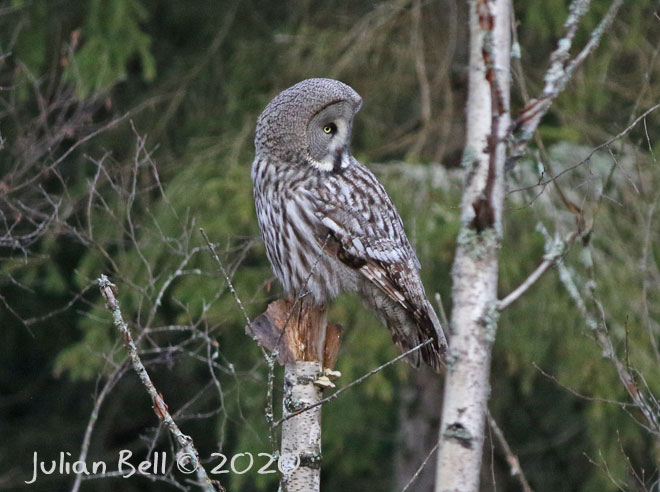
A week in Oslo was spent largely not out and about but managed a few walks. Highlight was on 26 January where we stumbled over a real cracker - although I knew they were in the area it was still magic to find it - away from the crowds of photographers. Great Grey Owl lappugle really is one of those dream birds.

Hunting Great Grey Owl lappugle
More pictures of this bird here

A small celebration was called for on the way home. Surely better than the Norwegian tradition of eating gullbrød (which I think is a chocolate covered marzipan bar) under such circumstances.

A special thank you to my better half for needing to find a secluded spot in the woods😃

Oslo Birder looking more like Urban Birder - studying two Pine Grosbeaks

Pine Grosbeaks konglebit cropped from a picture taken with my phone

On 27 January I was out in rather wet conditions with Oslo Birder (though he might also have a claim to the title of Urban Birder) to have another go for GGO but were not successful, though we did pick up a couple of Pine Grosbeaks konglebit in rather urban conditions.

Tuesday, January 28, 2020

Øygarden 20-22 January - YLG

On 20 January I was not really out but found the "yellow-legged" gull at Dåvøy again. Having discussed this bird recently with other birders I am rapidly coming to the conclusion that it is a real Yellow-legged Gull gulbeinmåke.

The beak looks massive, bulky and with a prominent gonys. The red spot bleeds over to the upper mandible.

Rather round headed, red orbital ring and eye seems to be a shade darker than the Herring Gulls


All white tip on P10 can be a feature of birds from parts of the Med. Obvious black band on P5


The small size is obvious here in comparison to the local HGs.

A quick look through this blog shows that this bird is most likely a bird that has been seen repeatedly over several years:

Some examples
2019 (Feb)

The fact that P10 can be white on YLG is shown here on gull research. I think I need to dig up some of my YLG shots from the Mediterranean🙂

On 21 Janaury a flock of 19 Common Scoter svartand on the east side of Blomøy was one of the largest flocks reported in the county thus far this year. When exactly did things get this bad?? Seaduck numbers seem to heading just one way - and it is the wrong way.

A short seawatch at Skogsøy on 22 January produced a Gannet havsule, several Kittiwake krykkje and finally some auks - though they were too far off to be specifically identified they were guillebills alke/lomvi. On the sea small numbers of Eider ærfugl and singles of Black Guillemot teist and Long-tailed Duck havelle. Best bird here was a fly over Snow Bunting snøspurv (first for Hordaland this year). Good numbers of Siskin grønnsisik too about with a single flock of 120 flying over.

Saturday, January 18, 2020

Øygarden 11-18 January 2020 - Back to work

Much less time out and about this week as work required some attention.

The first Dipper fossekall of the year turned up at Husvatnet on 14 January.

Other than that there was not much of note before 17 January when I birded an area I rarely cover. I had a couple of species in mind, neither of which showed and neither would have required a telescope.

Record shot of four Turnstone steinvender together with a Purple Sandpiper fjæreplytt

However, a feeding flock of gulls definitely required a scope and will need to be checked at the first opportunity. Among the Herring Gull gråmåke dominated flock a single Black-headed Gull hettemåke and a few Common Gulls fiskemåke were both new for me in Øygarden this year. The best sighting was a flock of four Turnstone steinvender resting on a nearby rock along with around 15 Purple Sandpipers fjæreplytt.

On my way back to the car the first local Woodpigeon ringdue of the year flew over.

Mistle Thrush duetrost

White-tailed Eagle havørn over the house - I actually took this picture only because I was carrying my camera from the car into the house when it flew over.


On 18 January I quickly refound the Mistle Thrush duetrost that was reported there yesterday - the first ever January record for the area despite there being a couple of historical December sightings.

Another Mute Swan knoppsvane turned up on 18 January to join the two long staying birds on Husvatnet.

Still plenty of finch flocks about - Brambling bjørkefink have been the most numerous to date but on 18 January a flock of 30 Chaffinch bokfink showed up - a very good midwinter flock around here.

Friday, January 10, 2020

Hjelme Vest, Dåvøy & Hatten 10 January 2020 - Calm weather clean up

Calm and sunny with a touch of frost.

I spent some time out and about trying to make the most of the cracking weather attempting to pick some of the "missing" species that I knew had to be around. This was largely successful with five more new for the Øygarden 2020 list.

First stop was Hjelme Vest, although a number of the hoped for target species failed to show. At least six Black Guillemots teist, 35 Long-tailed Duck havelle, a Curlew storspove and the first Gannet havsule of the year were the best of the sightings over the sea. No other auks, no divers and no grebes....

The woods were more productive too with the usual Crested Tits toppmeis along with Brambling bjørkefink and Redpoll gråsisik.

Next up was Dåvøy where the hoped for / expected Slavonian (Horned) Grebe horndykker showed. A Common Crossbill grankorsnebb flew over and there were 41 Grey Heron gråhegre at the roost.

A male and presumed female Two-barred Crossbill båndkorsnebb


Female Two-barred Crossbill båndkorsnebb

On the way home I popped in at Hatten where birds of the day were a flock of seven Two-barred Crossbill bånkorsnebb. A Jay nøtteskrike put in an appearance along with a selection of the usual woodland suspects.


Thursday, January 09, 2020

Skogsøy 09 January - Calmer conditions but no movement

Calmer conditions today and I was hoping for some kind of movement of birds displaced by the recent heavy winds. There was very little passing in the short time I sat there.

The walk in and out proved slightly more productive with a single Great Northern Diver islom heading north, four Mealy Redpoll gråsisik and a flock of around 60 Siskin grønnsisik.

Other than that it was the usual suspects including a few White-tailed Eagles havørn

Wednesday, January 08, 2020

Herdlevær 08 January 2020 - Unexpected auk

Still gale force winds but more from the west today. Mostly sunny but a few heavy sleet/hail showers.

The best birds were seen from the car at Skogsøy just before I got to Herdlevær with a Puffin lunde feeding in one of the channels. It was very closed but managed to disappear in the 45 seconds it took me to back up and get out of the car. This is normally a spring/summer bird out here and not often seen in January (perhaps not even annual). A solitary Starling stær was the first of the year too.

Herdlevær was very quiet with just a couple of White-tailed Eagles havørn and a Rock Pipit skjærpiplerke of any interest.

Tuesday, January 07, 2020

Hjelme Vest 07 January 2019 - Visibility pays off

The gale force winds continue but today much clearer and no rain - which meant there was enough visibility to give the sea another go.

Before I left I spent a couple of hours on a Skype call with work and had a massive Goshawk hønsehauk fly over the house - surely a female. Other birds seen during the call were a couple of White-tailed Eagles havørn and a Raven ravn or two. No bad start to the day.

Close inspection of this photo should reveal the White-billed Diver....

Obscene levels of cropping give this kind of image


Actually out and about the highlight was a cracking 2cy White-billed Diver gulnebblom. Although it gave excellent views in the scope it proved impossible to phone scope (no adaptor and too much movement). This bird looked very similar to the one I saw in the same place on 25 December. Although relatively regular locally in small numbers in the winter it is much less predictable at this time of year than during the spring passage and anyway is always a good bird to see.

Around 25 Long-tailed Duck havelle, a Black Guillemot teist and a couple of Purple Sandpipers fjæreplytt were among the other sightings along with the obligatory White-tailed Eagle havørn.


Monday, January 06, 2020

Dåvøy 06 January 2020 - Yellow legs.....

Near gale force southerly winds again but little rain. Little in the way of visibility so fairly hard going again today

Obviously darker than Herring Gull gråmåke (pro YLG feature)

Red spot on bill bleeding over to upper mandible - another pro YLG feature

Unfortunately the bird was spooked (possibly by Whooper Swans) before I managed to document the open wings...

This is the time of year those troublesome yellow-legged gulls turn up. Today a (the?) yellow legged gull turned up at Dåvøy - a regular spot for this to happen. It could potentially be a Yellow-legged Gull gulbeinmåke as it shows a number of pro YLG features - darker grey mantle, red eye ring, powerful bill with pronounced gonydal angle, red bill spot bleeding over to upper mandible, yellow legs, darker yellow eye and all white head. It was spooked by something before I managed to see the open wing properly - P10 looks to be all white (not good for YLG) but P5 does appear to be black (good for YLG). Or it could just be an omissus type Herring Gull gråmåke - hopefully some better shots of the wings will point ID in the right direction. The advanced moult (i.e. no streaking on the head) is obviously another pointer to YLG.

Red-breasted Merganser siland at Dåvøy

Also at Dåvøy the Grey Heron gråhegre roost numbered 46 birds which is a decent count.

A Peregrine vandrefalk hunted at Tjeldstø.

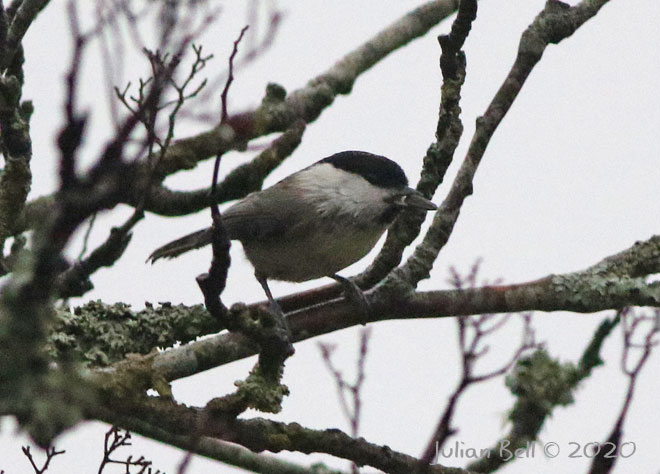
Willow Tit granmeis

The only definitely identified new for the year today were a couple of Willow Tit granmeis - although common enough inland it is not a common bird locally except during "invasion" years. In 2019 there were only three records of this species in Øygarden - none of which I managed to see.

Sunday, January 05, 2020

Oslo 31 December 2019 - Downtown birding

Although it is not exactly a secret that I am not a fan of birding in the parks of Oslo they are a good and easy way of getting up close and personal with a number of species.

Priority today was buying beer but I managed half an hour in the Botanical Garden at Tøyen. The park contains a wide variety of berry and seed bearing trees and is currently full of birds - many of which are relatively tame and easy to get close to.

Hawfinch kjernebiter

Waxwing sidensvans

Even though I was armed with just a simple point and pray superzoom it was straightforward to take pictures of some of the park's inhabitants.

Birds from my point of view were at least seven Hawfinch kjernebiter and the same number of Waxwing sidensvans.

Øygarden 05 January 2020 - Wash out

Heavy rain and strong southerly winds.

Although the winds were not as strong as yesterday the conditions were much worse with not much in the way of visibility.

I started at Hjelme West but there was not really the visibility to cover the best areas in the scope. Most of the target species were therefore not seen and I had to make do with a male Velvet Scoter sjøorre and a fly-by Curlew storspove.

Tjeldstø produced another local new for the year in the form of Siskin grønnsisik and a few Common Scoter svartand on the sea. The two Mute Swans knoppsvane were still present on Husvatnet.

Other species noted included the first Greenfinch grønnfink I've seen in Øygarden this year (they are rather scarcer than usual this winter), a couple of Redwing rødvingetrost and several White-tailed Eagles havørn.

A few Otters seen at various places including from my terrace.

Saturday, January 04, 2020

Skogsøy and Tjeldstø 04 January 2020 - Skogsøy blow out

Near gale force north westerly winds with some sleet / hail showers.

Given yesterday's Kittiwake at Nautnes I hoped that the winds might produce something at Skogsøy. I did not sit out there very long but there was almost nothing passing and it was one of the most disappointing Skogsøy trips ever. A few White-tailed Eagles havørn were present and being only the second day I have been in Øygarden there were a few local year ticks in the form of Eider ærfugl, Coal Tit svartmeis, Rock Pipit skjærpiplerke, Goldcrest fuglekonge and Goldeneye kvinand.

Mute Swans knoppsvane at Tjeldstø - a local rarity.

On the way home I spent some time at Tjeldstø which was MUCH better with two Mute Swans knoppsvane as the best sighting - similar to last year's winter sighting. This is only the sixth record of this species here although it seems like it is becoming more regular. Other sightings included a Woodcock rugde, a Snipe enkeltbekkasin, six Redwing rødvingetrost, a Fieldfare gråtrost, Rock Pipit skjærpiplerke and a Tree Sparrow pilfink.

Dying Robin rødstrupe at Solberg. The puffy eye may indicate some kind of disease


I also popped in at Solberg where the lack of sea duck was once again noticable. Only one Common Scoter svartand was present. A dying Robin rødstrupe sat in the path here, the puffy eye probably indicates some kind of disease. Of more interest was a hunting Peregrine vandrefalk and the 11th White-tailed Eagle havørn of the day.

Mother-of-pearl clouds perlemorskyer (polar strasospheric clouds)

Another observation of interest were polar stratospheric clouds - so called mother-of-pearl clouds (perlemorskyer) - particularly obvious as I left the house before the sun came up.

Nautnes & Tjeldstø 03 Janaury 2020 - First bird photo of the year

Very strong westerly winds with some showers.

The first bird I saw in Øygarden in 2020 was rather fittingly a White-tailed Eagle havørn flying over the road as I drove over the bridge at Toftøy.

2cy Kittiwake krykkje - photo taken from my terrace

I returned home in the early afternoon and the first bird I saw from my terrace was a storm blown Kittiwake krykkje. Not often they come so close to my house!

After that I had a quick look around in combination with a trip to the shops. Disturbingly a dead Whooper Swan sangsvane lay under the power lines that cross the nature reserve at Tjeldstø - it was being fed on by an adult White-tailed Eagle havørn and some Hooded Crows kråke. This dead swan was not there when I left just before New Year and it is not unreasonable to imagine that it was panicked on New Years eve and collided with the power lines in the dark.

Other species noted included a Peregrine vandrefalk flying over the shops, a Sparrowhawk spurvehauk and small numbers of Brambling bjørkefink.